Best OLED TVs 2026: Expert Picks
OLED is the pinnacle of TV picture quality. Every pixel produces its own light and switches off completely for true black, delivering infinite contrast that no backlight-based TV can match. We ranked 10 OLED models — spanning last-gen closeout deals, the new 2026 C6, a 65" C5, and LG's breakthrough Tandem OLED G5 — to determine which delivers the best picture for your money.
The C6 pushes brightness and processing forward again: reviewers measured it brighter than the C5 it replaced. And the G5 introduces Tandem OLED, stacking two OLED layers for a brightness leap that addresses OLED's historical weakness against Mini-LED.
At a Glance: Top OLED Picks
Five standouts from the full field of 10. Every model is ranked and reviewed below, and each earns its spot for a different reason.
| Feature | Editor's Pick LG 55" OLED C6 | LG 65" OLED C5 | LG 55" OLED C4 | Samsung 65" S90H | LG 55" OLED G5 |
|---|---|---|---|---|---|
| Price Band | Flagship | Flagship | Flagship | Flagship | Flagship |
| Screen Size | 55" | 65" | 55" | 65" | 55" |
| Panel Type | WOLED (OLED evo) | WOLED evo | WOLED evo | WOLED (matte) | Tandem OLED (Primary RGB) |
| Resolution | 4K UHD | 4K UHD | 4K UHD | 4K UHD | 4K UHD |
| Refresh Rate | 120Hz (165Hz VRR) | 120Hz (144Hz VRR) | 120Hz | 120Hz (165Hz PC) | 120Hz |
| HDR Formats | Dolby Vision, HDR10, HLG | HDR10, Dolby Vision IQ, HLG | HDR10, Dolby Vision IQ, HLG | HDR10+, HDR10 | HDR10, Dolby Vision IQ, HLG |
| Smart Platform | webOS 26 | webOS | webOS | One UI Tizen | webOS |
| Check Price | Check Price | Check Price | Check Price | Check Price |
Every OLED TV, Ranked
1. LG 55" OLED evo C6 4K Smart TV (2026) — Dim and mixed-light rooms: movies, streaming and gaming on one OLED
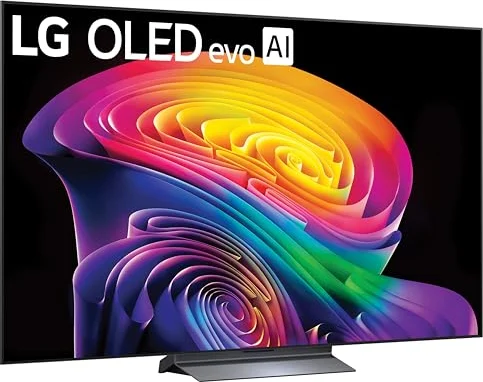
The C6 is the OLED to buy for a dim or mixed-light room: reviewers measured it brighter than the C5, it keeps four full HDMI 2.1 ports and adds 165Hz for PC gaming. Its glossy screen is the catch in bright rooms.
Pros
- Measured brighter than the C5 (TechRadar: about 1,430 nits on a 10% HDR window)
- Four full-bandwidth HDMI 2.1 ports; 4K/120 for consoles, up to 165Hz for PC
- Self-lit pixels: perfect blacks with no blooming
Cons
- Glossy screen reflects lamps and windows (RTINGS: "just okay" reflection handling)
- No HDR10+, no DTS and no ATSC 3.0 tuner
- US model drops to Wi-Fi 5 and two USB ports (the C5 had Wi-Fi 6E and three)
2. LG 65" OLED evo C5 Smart TV (2025) — Living rooms where 65" is the ideal size for OLED perfection
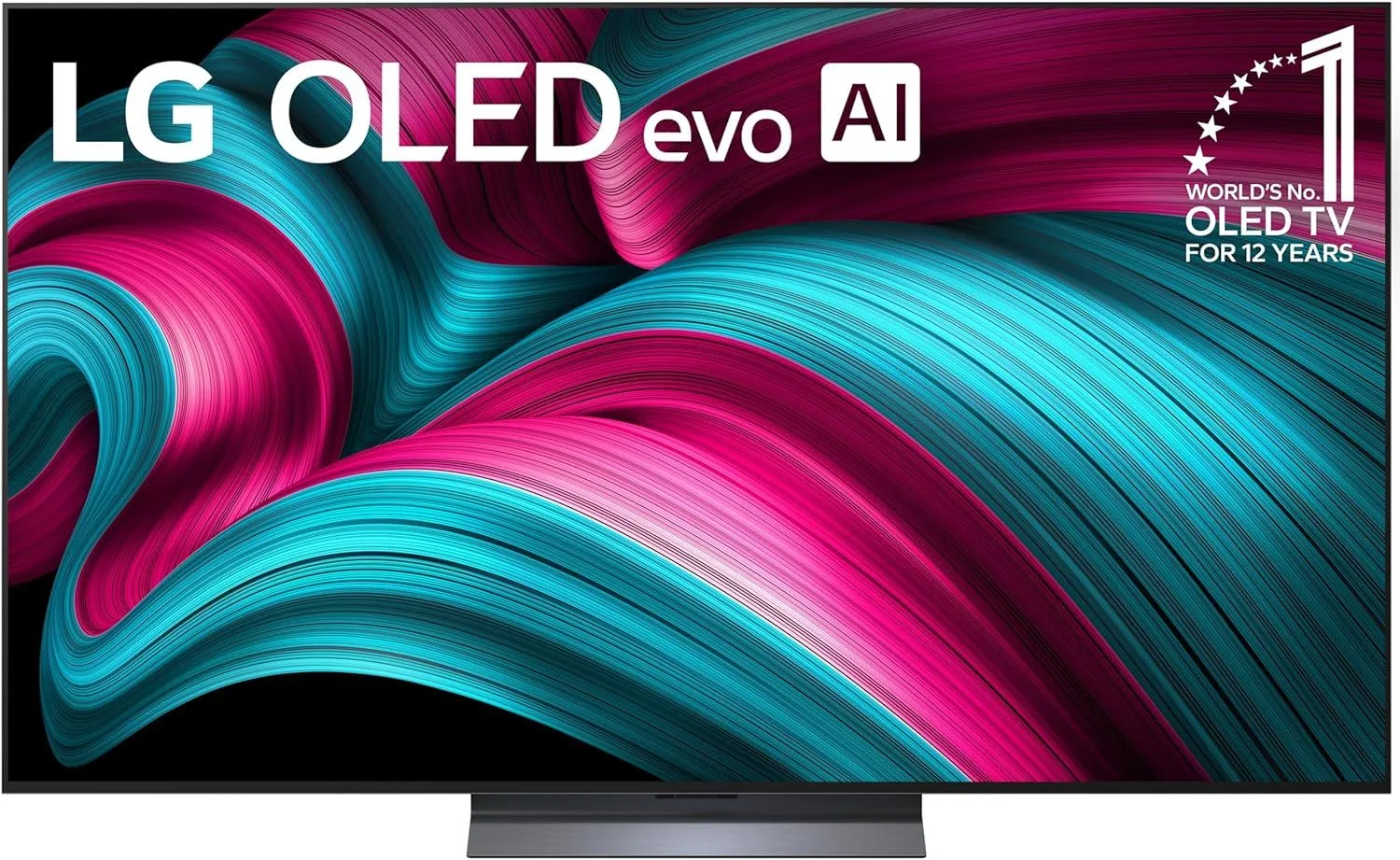
If 55" feels too small for your living room, the 65" C5 scales the same OLED excellence to a larger canvas. The price jump is significant, but OLED at 65" is a transformative viewing experience.
Pros
- Same benchmark C5 OLED quality at 65"
- 4x HDMI 2.1 for the ultimate gaming setup
- Perfect blacks with improved brightness over C4
Cons
- Significant price jump from 55" C5
- Still not as bright as Mini-LED for HDR
- Burn-in risk with static content like news tickers
3. LG 55" OLED evo C4 Smart TV (2024) — Value-conscious OLED buyers who want the C-series at a discount
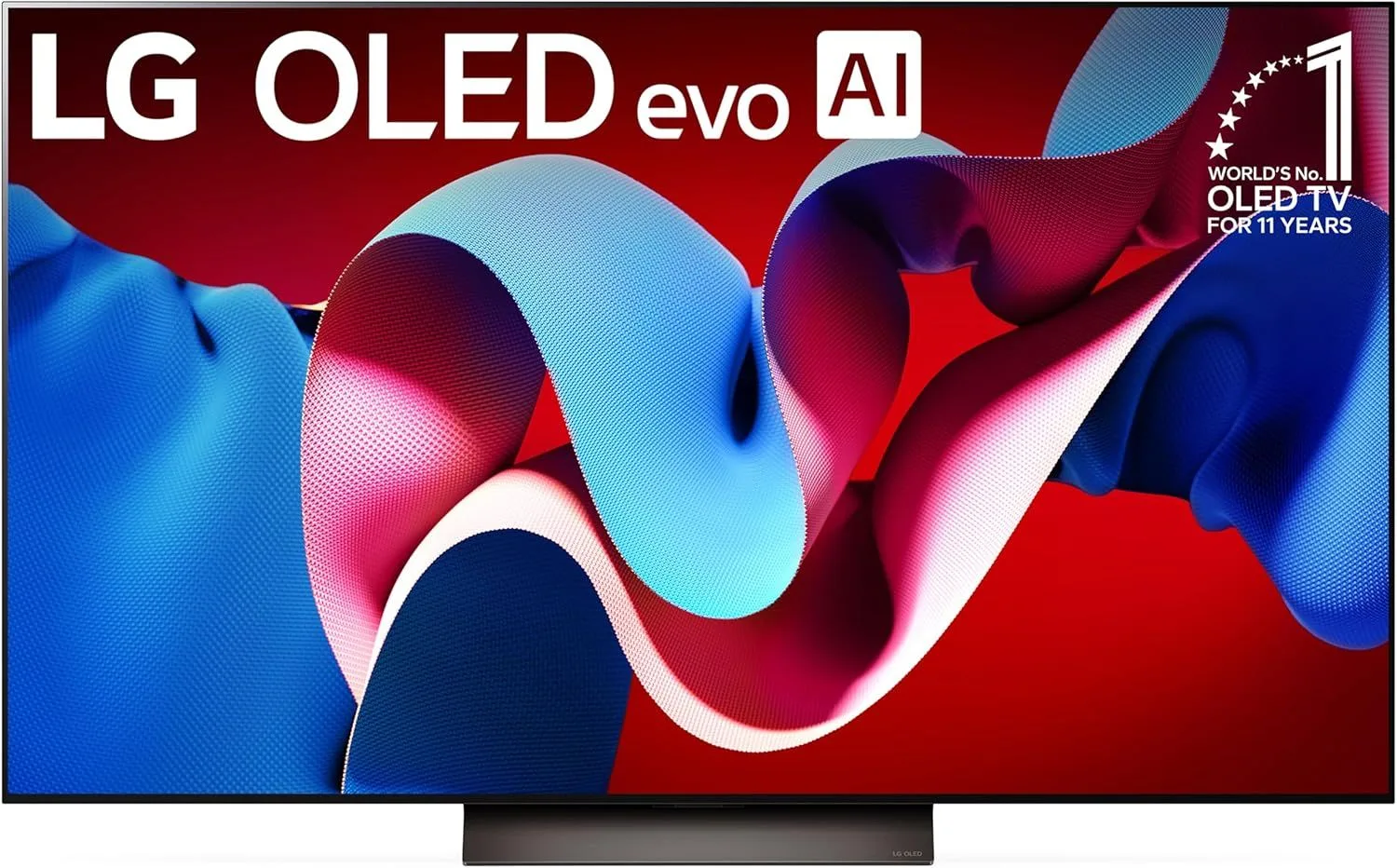
Last year's C-series at a steep discount offers 90%+ of the C5 experience. If OLED picture quality matters more to you than having the latest processor, this is the smart buy while stock lasts.
Pros
- OLED picture quality at closeout pricing
- 4x HDMI 2.1 for gaming — <1ms response time
- Dolby Vision IQ and Filmmaker Mode
Cons
- Previous generation — C5 has better brightness and processor
- Lower peak brightness than C5
- Gradually being discontinued — stock limited
4. Samsung 65" S90H OLED 4K Smart TV (2026) — Bright-room OLED gaming, with Game Motion Plus for 30 fps console games
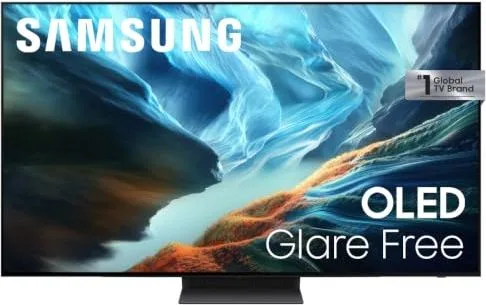
The S90H is the OLED for a brighter room: its matte screen tames reflections that the LG C6's glossy one shows, and Game Motion Plus can smooth 30 fps games in game mode. It has no Dolby Vision and dims hard on bright full-screen scenes.
Pros
- Matte Glare Free screen does an "outstanding job" against direct reflections (RTINGS)
- Game Motion Plus smooths console games in game mode (Samsung); four full HDMI 2.1 ports up to 165Hz (RTINGS)
- Tom's Guide measured 9.3ms input lag at 4K/60 and about 1,497 nits on a 10% HDR window (55")
Cons
- No Dolby Vision, so no Dolby Vision gaming on Xbox (RTINGS)
- Aggressive ABL: considerably dimmer when much of the scene is bright (RTINGS)
- Noticeable stutter in slow pans; Game Motion Plus switches off when VRR is on (RTINGS, Samsung)
5. LG 55" OLED evo G5 Gallery Smart TV (2025) — Premium buyers and wall-mount enthusiasts wanting the brightest OLED
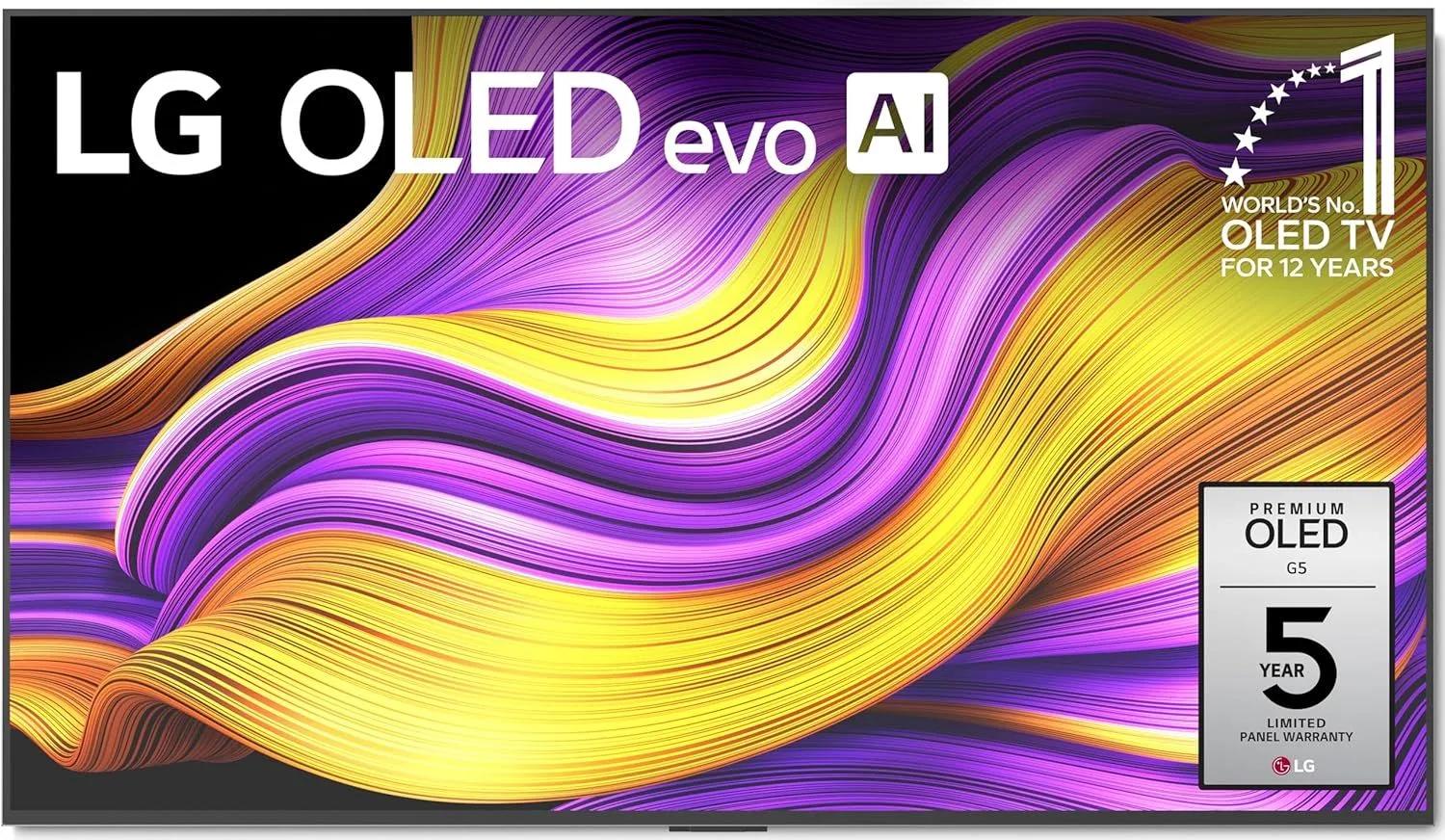
The G5 is the future of OLED — tandem technology doubles brightness while maintaining per-pixel contrast. If you're wall-mounting and want the absolute best OLED picture, this is it.
Pros
- Tandem OLED doubles light output — brightest OLED available
- Gallery Design mounts perfectly flush to walls
- Reference-level color reproduction and anti-reflection
Cons
- No stand included — wall-mount only unless bought separately
- First-gen tandem OLED in consumer TVs
- Significant premium over C5 for brightness gains
6. LG 65" OLED B6 4K Smart TV (2026) — Dark-room console gaming on an OLED for less than the C6
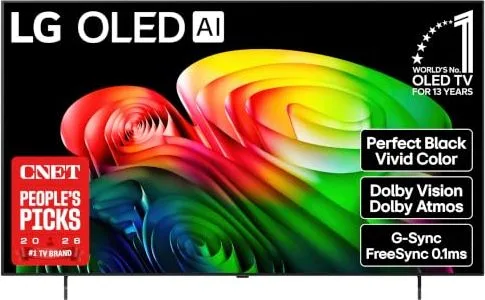
The B6 is the cheapest way into a current LG OLED: the same low lag and four HDMI 2.1 ports as the C6, at 120Hz rather than 165Hz. It is much dimmer and handles reflections poorly, so it belongs in a dark room.
Pros
- Tom's Guide measured 8.9ms input lag at 4K/60 with Boost, matching the C6
- Four full-bandwidth HDMI 2.1 ports and full PS5 Pro and Xbox support, including Dolby Vision gaming (RTINGS)
- RTINGS calls it a "great TV for most uses"
Cons
- Much dimmer than the C6: Tom's Guide measured 695 nits on a 10% HDR window against the C6's 1,251 in Standard mode
- Glossy screen that RTINGS calls ineffective against mirror-like reflections
- Noticeable stutter in slow pans, and motion smoothing outside game mode is inconsistent (RTINGS)
7. LG 65" OLED evo C6 4K Smart TV (2026) — Dim and mixed-light living rooms: console gaming, movies and streaming on one OLED
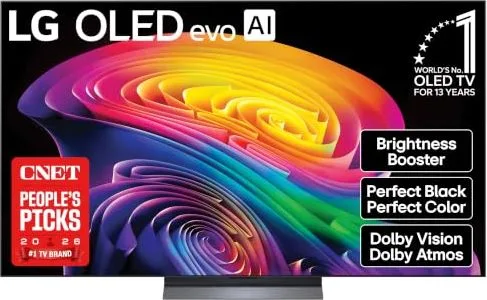
The 65" C6 is the all-round OLED for a dim or mixed-light room: RTINGS calls it a fantastic choice for gaming, with incredibly low input lag and four full HDMI 2.1 ports. The catches are stutter in slow pans and a glossy screen that struggles opposite bright lights.
Pros
- Incredibly low input lag (RTINGS); Tom's Guide measured 9.1ms at 4K/60 with Boost
- Four full-bandwidth HDMI 2.1 ports and full PS5 and Xbox support, including Dolby Vision gaming (RTINGS)
- Tom's Guide measured about 1,355 nits on a 10% HDR window, well above the B6
Cons
- Near-instant response means noticeable stutter in slow pans (RTINGS)
- Glossy screen: RTINGS rates its handling of direct reflections only "okay"
- No HDR10+; RTINGS found distracting near-black vertical banding on its unit
8. LG 77" OLED evo C6H 4K Smart TV (2026) — Big-screen OLED gaming and movies in a dim or mixed-light room
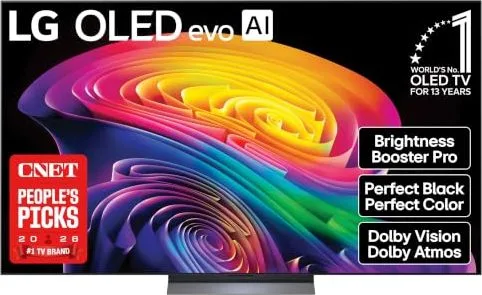
The C6H is the big-screen pick: at 77 inches it is far brighter than the smaller C6, with the same low lag and four HDMI 2.1 ports. RTINGS's sample had uniformity problems, so check the panel early and buy where returns are easy.
Pros
- Far brighter than the 65" C6 in game mode: RTINGS measured 2,057 nits on its Hallway Lights scene (C6: 1,165)
- Incredibly low input lag (RTINGS); four full HDMI 2.1 ports and 165Hz with a PC
- Tandem panel with stronger colour than the smaller C6 sizes (RTINGS)
Cons
- RTINGS's unit had severe near-black vertical banding and uneven uniformity
- Very noticeable stutter in slow pans (RTINGS)
- Glossy screen with mediocre handling of direct reflections (RTINGS)
9. Samsung 48" S85H OLED 4K Smart TV (2026) — A desk-size OLED for dark-room console gaming
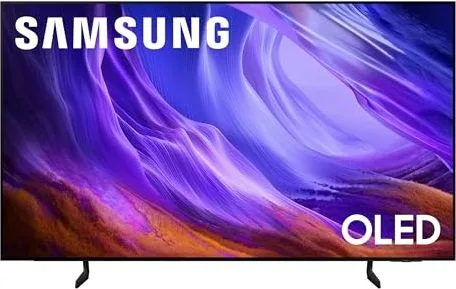
The 48" S85H is the low-cost desk OLED: low lag, four HDMI 2.1 ports and Game Motion Plus for 30 fps games. It is dim and glossy, so it suits a dark room.
Pros
- A 48" OLED for a desk or small dark room; RTINGS says its results apply to all sizes
- Tom's Guide measured 9.2ms input lag at 4K/60; four full HDMI 2.1 ports (RTINGS)
- Game Motion Plus for smoothing console games in game mode (Samsung)
Cons
- Very noticeable stutter in slow pans and wide shots (RTINGS)
- Glossy screen: RTINGS says it is far less ideal for even a moderately lit room
- Dim for HDR (Tom's Guide measured 771 nits on a 10% window, 65") and no Dolby Vision
10. LG 42" OLED evo C6 4K Smart TV (2026) — A desk or small room where a 42" OLED doubles as a gaming monitor
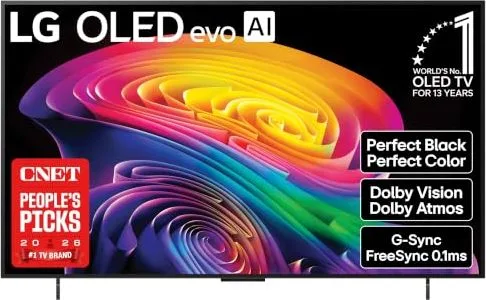
The 42" C6 is the TV-or-monitor answer: the C6's gaming features at desk size. It skips the Brightness Booster of the larger sizes, so expect a dimmer picture than reviews of the 65" describe.
Pros
- The C6 line's gaming features at desk size: four HDMI 2.1 ports and up to 165Hz with a PC (LG)
- Incredibly low input lag in Game Optimizer on the C6 (RTINGS, 65" tested)
- LG promises up to five years of webOS updates (LG)
Cons
- No Brightness Booster: RTINGS says it is not as bright as the larger C6 sizes
- Lab results from RTINGS and Tom's Guide are for the 65"; no 42" was measured
- Glossy screen and noticeable stutter in slow pans (RTINGS, 65")
Our #1 OLED Pick
Check Price on AmazonHow We Ranked These OLEDs
Every one of the 10 OLEDs here earns its position through:
- Picture quality per dollar — OLED is a premium technology, so value matters intensely. The C4 at closeout pricing delivers picture quality close to the newer C5 and C6 at a lower cost, which earns it a high ranking. The G5 charges more but delivers new capability.
- Dark room performance — OLED buyers typically care about dark room movie watching. We ranked each TV on the published measurements that matter for dark content: shadow detail in dimly lit scenes, letterbox bar uniformity, and near-black gradient handling.
- Gaming capability — All four models include 4x HDMI 2.1 ports with 120Hz and sub-1ms response time. We evaluated VRR implementation, input lag consistency, and each model's game mode picture quality versus default modes.
- HDR performance — Despite lower peak brightness than Mini-LED, OLED's per-pixel contrast makes HDR content look stunning. We evaluated Dolby Vision IQ performance, HDR tone mapping, and highlight detail retention.
- Long-term considerations — Panel generation (the C4's older panel vs the newer C5 and C6), warranty coverage, and burn-in protection features factor into the ranking for buyers thinking beyond the first year.
OLED Buying Guide: Choosing the Right Model
C4 vs C6: Last-Gen Savings or Current-Gen Performance?
The C4 at closeout pricing is the most affordable path into LG OLED. It uses the a9 Gen7 processor and a slightly dimmer WOLED panel. The 2026 C6 upgrades to the alpha 11 Gen3 processor with better upscaling and AI picture adjustment, adds VRR up to 165Hz for PCs, and measured about 1,430 nits on a 10% HDR window in TechRadar's tests (the C5 it replaced measured about 1,180 on the 65-inch). In a dark room side-by-side, the C6 is noticeably brighter in HDR highlights. In everyday streaming content, the difference is subtle. If you are replacing a non-OLED TV, the C4 will be revelatory regardless.
55" vs 65": Size and Viewing Distance
OLED panels maintain their quality regardless of size — unlike Mini-LED where larger panels can have more blooming. The choice is purely about room fit. At 6-8 feet of viewing distance, 55" is ideal and more immersive than you might expect thanks to OLED's contrast. At 8-10 feet, 65" fills the field of view more naturally. The price per inch is better at 55", so the 65" C5 is a premium for physical size rather than picture quality improvement.
OLED vs Mini-LED: Still the Right Call?
If you are weighing OLED against Mini-LED alternatives, our OLED vs Mini-LED comparison covers every angle: contrast, brightness, gaming, viewing angles, and price. For most dark-room viewers, OLED remains the superior technology.
C6 vs G5: Standard vs Tandem OLED
The G5 represents a generational leap. Tandem OLED stacks two OLED layers, pushing light output to around 1,800 nits. This addresses OLED's biggest weakness — brightness in HDR content and bright rooms. The G5 also includes an anti-reflection coating and a gallery-style flush-mount design (no stand included). The C6 remains the better all-around value. The G5 is for enthusiasts who want the absolute best OLED picture and plan to wall-mount.
Gaming on OLED: The Gold Standard
All four OLEDs in this roundup include 4x HDMI 2.1 ports, 120Hz, VRR, ALLM, and sub-1ms response time. OLED is widely considered the best display technology for gaming due to instant pixel response and zero motion blur. Every model here delivers identical gaming capability — the differences only matter for movies, brightness, and processing.
Frequently Asked Questions
Is OLED really worth the price premium over Mini-LED?
For dark room movie watching and gaming, yes. OLED delivers perfect blacks, infinite contrast, and pixel-level dimming that no backlight-based TV can match. The difference is most visible in dark scenes, letterboxed content, and games with high-contrast imagery. If you primarily watch in a bright room during daytime, Mini-LED may actually perform better for less money due to higher peak brightness.
Should I buy the LG C4 at clearout pricing or the newer C6?
The C4 at closeout delivers the core OLED experience at a real discount. The 2026 C6 adds a brighter picture (TechRadar measured about 1,430 nits on a 10% HDR window), LG's alpha 11 Gen3 processor and VRR up to 165Hz for PCs. If you are price-sensitive and can find C4 stock, it remains an excellent OLED. If you want the latest processor and maximum brightness, the C6 is the better long-term investment.
Is burn-in still a concern on modern OLEDs?
Burn-in risk on modern LG OLEDs is very low for typical home use. LG includes pixel refresher cycles, logo luminance adjustment, and screen saver features that actively prevent it. Years of long-term testing by RTings.com show that varied content (movies, games, streaming) produces no visible burn-in even after thousands of hours. The risk is real only with extremely static content displayed for many hours daily — think always-on news ticker or stock market displays.
What is the difference between the LG C6 and G5?
The G5 uses Tandem OLED technology — two stacked OLED layers that produce substantially more light than the single-layer WOLED panel in the C-series. The G5 reaches approximately 1,800 nits peak brightness, where TechRadar measured the C6 at about 1,430. The G5 also has an anti-reflection coating (the C6's screen is glossy) and a gallery-style design for flush wall mounting (no stand included). Choose the C6 for the best all-around OLED value; choose the G5 if you want maximum brightness and plan to wall-mount.
Why are there only LG OLEDs in this roundup?
At the price points we cover, LG dominates the OLED market with its C-series and G-series. Samsung OLED TVs (S95D, S90D) exist but start significantly higher in price and were outside our catalog scope. Sony OLED TVs (A95L) are also available but at flagship pricing. LG delivers the best OLED value across the widest range of sizes and price points.
Is the 65" C5 worth the jump from a 55-inch OLED?
At typical living room viewing distances of 7-10 feet, the 65" provides a more immersive experience for its 18% more screen area, and the price difference is significant. If your seating distance is under 7 feet, 55" is ideal (at that size the current C-series model is the 2026 C6). Over 8 feet, 65" will feel more appropriately scaled.
Our Top Pick
The LG 55" OLED evo C6 4K Smart TV (2026) earns the top spot. The C6 is the OLED to buy for a dim or mixed-light room: reviewers measured it brighter than the C5, it keeps four full HDMI 2.1 ports and adds 165Hz for PC gaming. Its glossy screen is the catch in bright rooms. It is the TV we recommend to anyone who can afford OLED — and the benchmark against which every other TV on this site is measured.