TCL 75" QM8L SQD-Mini LED 4K Google TV (2026) Review 2026
The QM8L is TCL's 2026 upper-mid-range Mini-LED and the successor to the QM8K. At 75 inches it pairs 2,584 dimming zones with brightness that labs put among the highest at its price, and this year it finally gets four full-speed HDMI 2.1 ports. The trade-offs are colour accuracy out of the box, some blooming from the sides, and a screen that still reflects bright lights.
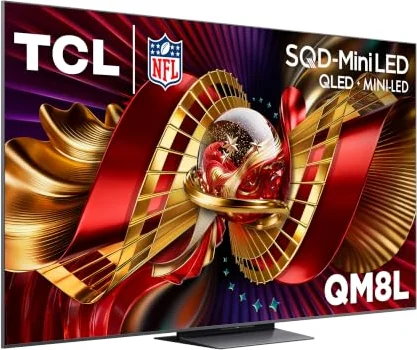
The QM8L is the bright-room Mini-LED for gamers: about 3,700 nits measured, 2,584 zones at 75 inches and, new this year, four full HDMI 2.1 ports. Expect to calibrate it, and sit near the middle.
What Changed From the QM8K
- Four full HDMI 2.1 ports instead of two. A newer MediaTek Pentonic 800 chip gives every input 48Gbps and 4K at up to 144Hz (Digital Trends; FlatpanelsHD confirmed 48Gbps on all four). This is the upgrade gamers will notice most.
- Wider colour. TCL's Super Quantum Dot (SQD) system uses single-colour Mini-LEDs behind improved quantum dots, a new colour filter and a colour-purity algorithm. The Future lab that tests for Tom's Guide and TechRadar measured about 90% of Rec.2020, up from about 80% on the QM8K; FlatpanelsHD measured 88% against 75% on the European models. TCL's "100% BT.2020" claim isn't met in any lab.
- Brighter highlights. FlatpanelsHD measured about 3,760 nits on a 10% window on the European 65-inch, "a 15% increase" over last year's model, with full-screen brightness essentially unchanged.
- More zones and finer control. FlatpanelsHD counted 2,040 zones on the 65-inch, about 21% more than before, and the backlight controller moved from 23-bit to 26-bit.
- Wi-Fi 6 and a new WHVA 2.0 Ultra wide-viewing-angle panel.
- Slightly worse accuracy. RTINGS found the QM8L has "slightly worse contrast" and is "significantly less accurate in HDR, even after a full calibration". The Future lab's Filmmaker Mode colour error rose from 2.7 to 3.7.
- Dolby Vision 2 Max is promised by a software update, but we found no confirmation it has shipped.
The QM8K is still covered in our TCL 75" QM8K review, and our TCL 75" QM6K vs QM8K comparison explains the gap between TCL's entry and upper Mini-LED tiers.
Picture: Brightness That Beats Daylight
On the 75-inch, the Future lab measured about 3,720 nits on a 10% HDR window and about 760 nits across a full white screen, both in Filmmaker Mode. TCL claims 5,500 nits for this size; the 6,000-nit figure on the Amazon listing is for the 98-inch. FlatpanelsHD's European 65-inch sustained about 3,500 nits and briefly passed 5,500 on a smaller window. In practice that means HDR highlights with real impact and a picture that stays bright with the curtains open.
Head-on, blooming control is excellent. Tom's Guide praised "deep blacks without blooming", and TechRadar saw no blooming in real viewing. From the side it is a different story: What Hi-Fi found blooming "much more obvious" from about 30 degrees off-centre, and FlatpanelsHD noted the same. This is a TV to watch from near the middle of the sofa.
Accuracy is the weak spot reviewers agree on. The Future lab measured a Filmmaker Mode colour error of about 3.7, and TechRadar recorded 9.9 in Standard mode; Tom's Guide also found the default brightness overwhelming. CGMagazine noted reds and blues running hot in Standard mode.
Switch to Filmmaker Mode first; reviewers found the default Standard mode far less accurate. If the picture still feels too intense in a dim room, lower the backlight rather than the contrast, and consider a professional calibration if accuracy matters to you.
Reflections: Better Than Most, Not Glare-Free
TCL advertises an anti-reflective layer. Reviewers found it "mild": What Hi-Fi called the screen "quite reflective of bright light sources", and Digital Trends said the glossy panel "does pick up direct reflections more than I'd like". RTINGS rates it slightly worse than the cheaper QM7L at direct reflections. The saving grace is brightness: at around 3,700 nits, it overpowers ambient light better than almost anything near its price. See our best TVs for bright rooms for matte-screen alternatives.
Gaming: Four Fast Ports at Last
All four HDMI inputs run 4K at up to 144Hz, and 1080p or 1440p at up to 288Hz. VRR covers 48 to 288Hz with AMD FreeSync Premium Pro (FlatpanelsHD found G-Sync worked, though the TV isn't certified), plus ALLM and TCL's Game Bar. The eARC soundbar connection is on HDMI 1. Input lag measured about 9.5ms on the 75-inch in the Future lab. TechRadar gave it five out of five for gaming. Dolby Vision gaming is listed for the European model; we couldn't confirm it for the US set. More in our gaming TV guide.
Sound, Smart Features and the Details
The US model has a 2.2-channel Bang & Olufsen system with down-firing speakers and two rear woofers, Dolby Atmos, DTS:X and virtual height processing. TCL declined to give Tom's Guide a wattage figure. (The European C8L has a different, up-firing speaker system, so European audio reviews don't apply.) TechRadar found it good enough to skip a soundbar, despite light bass; Digital Trends called it "merely fine".
- Google TV with Gemini. TCL makes no OS-update commitment, which FlatpanelsHD criticised, and it also flagged home-screen ads.
- HDR formats: Dolby Vision IQ, HDR10+, HDR10, HLG and IMAX Enhanced.
- ATSC 3.0 tuner for NextGen TV broadcasts (all reviewers agree), Wi-Fi 6 and Bluetooth 5.4.
- Stand: a centre pedestal with two heights and cable management; CGMagazine and Digital Trends found it plasticky. The 75-inch weighs about 63 pounds without it.
Strengths
- ✓One of the brightest TVs at its price (Future lab: about 3,720 nits on a 10% HDR window, 75")
- ✓Four full-bandwidth HDMI 2.1 ports at 4K/144Hz, VRR 48-288Hz (the QM8K had two)
- ✓2,584 local dimming zones at 75" with excellent halo control head-on
Cons
- ✗Colour accuracy out of the box is mediocre (Delta E about 3.7 in Filmmaker Mode)
- ✗Blooming becomes visible from off-axis seats (What Hi-Fi)
- ✗Screen still reflects bright light sources
What Owners Report
Owner discussions on Reddit (r/tcltvs, September and October 2026) are largely positive. A 75-inch owner after a month praised the bright picture and rich colour and noticed little blur in football and soccer; another 75-inch owner after nearly two months was happy with NBA games and Switch 2 gaming. Several owners, at 75 inches and other sizes, report no ghosting with an Xbox Series X. Like the reviewers, some found the default picture too saturated, with reds pushed, and adjusted it.
The main complaint is "reverse blooming", where dark areas around bright objects look wrong in Dolby Vision scenes. Several owners reported it, and one returned the TV over it; a 75-inch owner then reported that a manual firmware update (V116) removed the effect, so it is worth checking for updates first. A minority of owners found motion blur in sport and games bad enough to return the set. These are individual reports, not a defect rate.
What the Reviews Say
Reviews are strong: 4.5 out of 5 from TechRadar, 9 out of 10 from CGMagazine, 8 from Digital Trends (which called it "the TV to beat for 2026"), 4 from Tom's Guide, five stars from What Hi-Fi and Highly Recommended from FlatpanelsHD for the European version. They agree on brightness, halo control, colour volume and the HDMI upgrade, and on mediocre out-of-box accuracy. They differ on off-axis blooming and on value: RTINGS and Tom's Guide suggest the cheaper QM7L, or a discounted QM8K, may suit most people better.
QM8L vs the Alternatives
- TCL QM7L: the value alternative. In the same lab at 75 inches it measured about 2,270 nits against the QM8L's 3,720, with nearly identical colour coverage, but it has only two fast HDMI ports, Wi-Fi 5 and a disputed tuner spec. TechRadar put its picture at about 97% of the QM8L's.
- TCL QM8K (2025): RTINGS found it has slightly better contrast and HDR accuracy, but only two HDMI 2.1 ports and narrower colour. See our QM8K review.
- TCL 75" QM6K: the budget 75-inch Mini-LED, with far fewer zones and much lower brightness at a much lower price.
- Samsung QN90H: Samsung's 2026 matte-screen Mini-LED. We found no direct comparison yet, so we can't say which is better.
Who Should Buy the QM8L, and Who Shouldn't
Buy it if your living room is bright, you want a 75-inch TV with near-flagship HDR, or you connect several consoles or a gaming PC and want every port to run at full speed.
Look elsewhere if you want accurate colour without calibrating, your seating is spread wide around the room, you want a 55-inch (the QM8L starts at 65), or you want the best value; the QM7L delivers most of the picture for less.
Frequently Asked Questions
What is the difference between the TCL QM8L and the QM8K?
Three things matter most. The QM8L has four full-bandwidth HDMI 2.1 ports instead of two, thanks to a newer MediaTek Pentonic 800 chip. Its Super Quantum Dot system widens colour from about 80% to about 90% of Rec.2020 (Future lab, used by Tom's Guide and TechRadar). And it is brighter: FlatpanelsHD measured about 15% more on the European 65-inch version. RTINGS adds that HDR accuracy and contrast are slightly worse than on the QM8K.
How bright is the 75-inch TCL QM8L?
The Future lab measured about 3,720 nits on a 10% HDR window in Filmmaker Mode and about 760 nits full-screen. TCL claims 5,500 nits for the 75-inch; the "up to 6,000 nits" on the Amazon listing refers to the 98-inch model.
How many dimming zones does the 75-inch QM8L have?
2,584, according to Tom's Guide. The 65-inch has 2,040. The "4,000+ zones" headline applies to the 98-inch.
Is the QM8L good for gaming?
It is one of the best-equipped gaming TVs at its price. All four HDMI ports run 4K at up to 144Hz, VRR covers 48 to 288Hz with AMD FreeSync Premium Pro, and the Future lab measured about 9.5ms input lag. TechRadar gave it five out of five for gaming.
Is the QM8L accurate out of the box?
Not especially. The Future lab measured an average colour error (Delta E) of about 3.7 in Filmmaker Mode, and TechRadar recorded 9.9 in Standard mode. RTINGS calls its HDR significantly less accurate than the QM8K's even after calibration. Use Filmmaker Mode as a starting point and expect to adjust.
Final Verdict
The QM8L is the bright-room Mini-LED for gamers: about 3,700 nits measured, 2,584 zones at 75 inches and, new this year, four full HDMI 2.1 ports. Expect to calibrate it, and sit near the middle.
If brightness and gaming connectivity top your list, the 75-inch QM8L is one of the strongest TVs at its price in 2026. If you mainly watch films in a dim room and value accuracy, the QM7L or an OLED may be the better fit.
Sources
This review is based on the manufacturer's published specifications, on reviews and lab measurements by the outlets below, and on owner reports. We have not tested the TV ourselves; where a figure comes from a specific reviewer, it says so. Tom's Guide and TechRadar share one test lab, so their identical measurements count as one source.
- TCL 2026 SQD-Mini LED line-up press release (reproduced by LEDinside)
- Tom's Guide, TCL QM8L review, Sean Captain (75")
- TechRadar, TCL QM8L review, James Holland (75")
- Digital Trends, TCL QM8L review, Andre Revilla (85")
- CGMagazine, TCL QM8L review, Brendan Frye (75")
- FlatpanelsHD, TCL C8L (European QM8L) review, Eric Beeckmans (65")
- What Hi-Fi?, TCL C8L review, Tom Parsons (65")
- RTINGS, TCL QM8L review (65")
- RTINGS, TCL QM8K vs QM8L comparison
- Tom's Guide, TCL QM8L vs QM8K
- RTINGS, TCL QM7L vs QM8L comparison
- Reddit r/tcltvs, "QM8L reverse bloom" owner thread (October 2026)
- Reddit r/tcltvs, "QM8L 75 after a month of ownership" (September 2026)