OLED vs Mini-LED TVs: Complete Technology Comparison 2026
OLED delivers perfect blacks and sub-1ms response times through self-emissive pixels. Mini-LED fights back with 2-3x higher peak brightness and zero burn-in risk using thousands of dimmable LED zones behind an LCD panel. For dark rooms and gaming, OLED wins. For bright rooms and maximum HDR punch, Mini-LED takes it. Both technologies are excellent in 2026 — the right choice depends on your room and viewing habits.
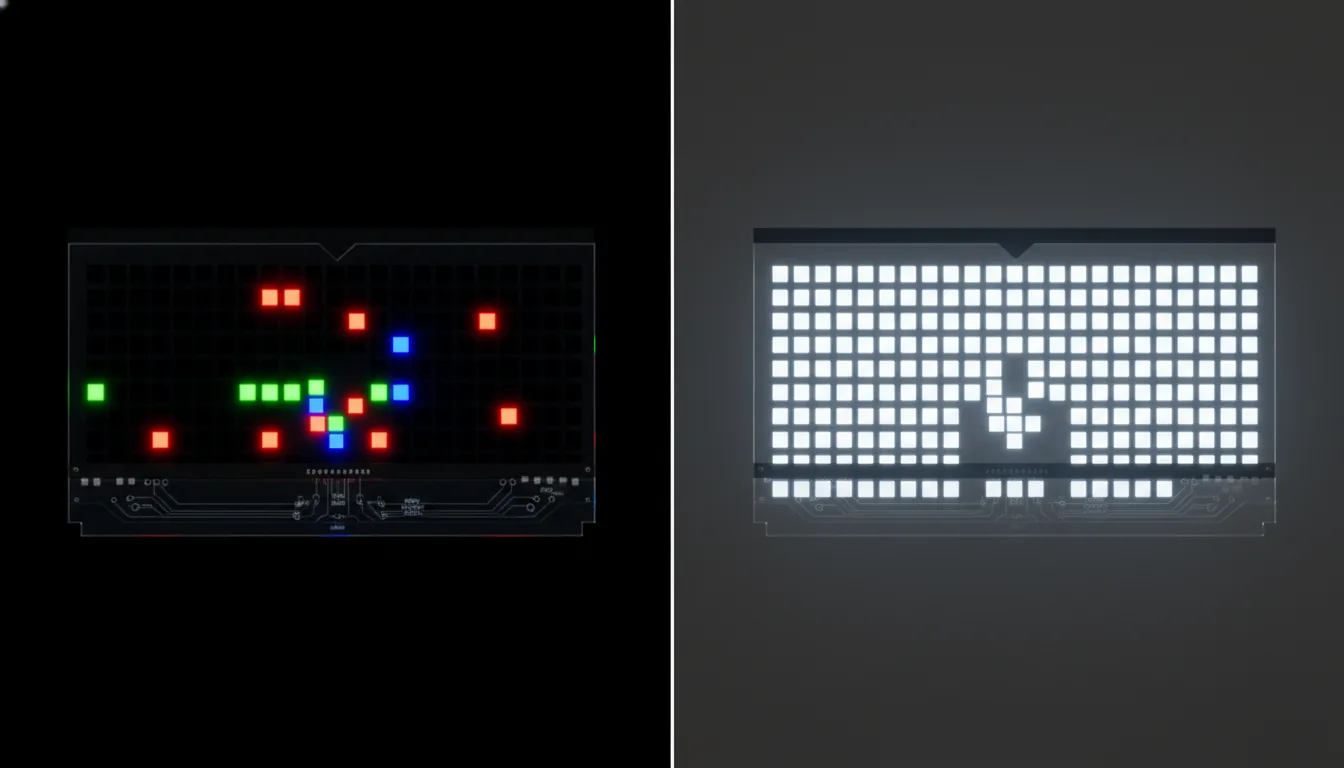
The Fundamental Technology Split
OLED and Mini-LED solve the same problem — reproducing a realistic picture on a flat screen — using completely opposite approaches. That fundamental difference explains every strength and weakness of each technology.
OLED (Organic Light-Emitting Diode) uses self-emissive pixels. Each of the 8.3 million pixels in a 4K panel produces its own light and can switch off completely. When a pixel is off, it emits zero photons. The result: true black, infinite contrast ratio, and no light bleed between adjacent bright and dark areas. The LG C5 OLED achieves a contrast ratio that measuring instruments literally cannot quantify because the "off" measurement is zero.
Mini-LED uses a conventional LCD panel with a dense array of tiny LED backlights arranged in hundreds or thousands of independently dimmable zones. When a scene has a bright object against a dark background, the zones behind the dark area dim while the zones behind the bright object stay lit. The TCL QM7K packs over 1,000 dimming zones, while the Samsung QN70F uses a similar high-density approach. More zones mean finer control — but each zone still covers dozens of pixels, not individual ones.
Contrast and Black Levels: The Biggest Difference
Contrast is the single most impactful picture quality metric. It determines how realistic and three-dimensional an image looks, and it is where OLED and Mini-LED diverge the most.
OLED: Infinite Contrast, Zero Compromise
When an OLED pixel turns off, it produces no light at all. In a pitch-dark room, the black areas of the screen are indistinguishable from the bezel. Letterboxed movies display perfectly black bars. A night sky full of stars shows pinpoint white dots against absolute darkness. There is no halo, no glow, no gray-ish cast. This per-pixel light control is something no backlit technology can replicate.
Mini-LED: Very Good, But Not Perfect
Mini-LED achieves excellent contrast by modern LCD standards — measured ratios of 15,000:1 to 30,000:1 depending on zone count and processing. But the zone-based dimming creates a visible artifact called "blooming." When a bright white subtitle appears over a black letterbox bar, the backlight zone behind the text also illuminates a faint halo of gray around it. The higher the zone count, the smaller and less noticeable the halo — but it never fully disappears.
| Spec | OLED | Mini-LED |
|---|---|---|
| Contrast Ratio | Infinite (per-pixel) | 15,000:1 – 30,000:1 |
| Peak Brightness | 800–1,800 nits | 1,200–3,000 nits |
| Black Level | 0 nits (absolute black) | 0.01–0.05 nits |
| Response Time | < 1ms | 4–8ms (LCD panel) |
| Viewing Angle | Wide (60°+ with minimal loss) | Moderate (VA panels wash out at 25–30°) |
| Burn-In Risk | Low (mitigated, not eliminated) | None (physically impossible) |
| Typical Price (55") | $800–$1,800+ | $400–$1,200 |
Brightness: Where Mini-LED Dominates
Peak brightness is Mini-LED's strongest card. The backlighting architecture allows manufacturers to crank up luminance far beyond what organic compounds can sustain. A standard OLED like the LG C5 peaks around 1,000 nits in a 10% HDR window. The tandem-stack LG G5 pushes that to roughly 1,800 nits by layering two OLED panels — a substantial jump but still not enough to close the gap entirely.
Premium Mini-LED TVs routinely exceed 2,000 nits, with flagships reaching 2,500-3,000 nits. That extra brightness translates into more impactful HDR specular highlights — the glint off a car hood, an explosion, sunlight reflecting off water. In content mastered for high peak brightness, Mini-LED delivers highlights that physically pop in a way OLED cannot match.
Brightness also determines bright-room performance. In a living room with floor-to-ceiling windows, a Mini-LED TV powered by 2,000+ nits fights ambient light far more effectively than a 1,000-nit OLED. Samsung's QN70F pairs high brightness with the industry's best anti-reflection coating, making it a superior daytime TV.
Brightness specs can be misleading. Manufacturers measure peak brightness on a small window (2-10% of screen). Full-screen sustained brightness is typically 40-60% of the peak number. A "3,000 nit" Mini-LED might sustain 1,200 nits full-screen — and a "1,000 nit" OLED might sustain 400 nits. For bright rooms, sustained brightness matters more than the marketing peak.
The Burn-In Question: Settled but Not Gone
Burn-in is the permanent retention of static image elements on an OLED screen. It happens because the organic compounds in OLED pixels degrade at different rates — a pixel displaying a bright logo for thousands of hours wears out faster than surrounding pixels, leaving a faint ghost image.
Modern OLED TVs have aggressive mitigation: pixel-shift routines that move the image by a few pixels periodically, automatic brightness limiters on static elements, logo-detection algorithms that dim detected static graphics, and periodic pixel-refresh cycles that run when the TV is in standby. LG's warranty covers burn-in for the first few years.
For normal home use — varied content, mixed viewing hours, no single channel running 18 hours a day — burn-in is extremely unlikely on a 2024 or later OLED. The risk becomes real only for commercial signage, airport information displays, or TVs permanently tuned to a single news channel with a fixed ticker and logo.
Mini-LED eliminates burn-in entirely. LCD panels with LED backlighting use no organic compounds. Static content can run indefinitely without any degradation pattern. For hotel rooms, gym displays, or any commercial installation, Mini-LED is the safer bet purely on longevity grounds.
Burn-in vs image retention: Temporary image retention (a faint ghost that fades after a few minutes) is normal on both OLED and LCD. True burn-in is permanent and only affects OLED. If you see a ghost image on your OLED after watching a channel with a static logo, switch to varied content for 10 minutes — if it disappears, it was retention, not burn-in. See our full burn-in guide for detailed data.
HDR Performance: Different Strengths
HDR (High Dynamic Range) content is designed to show both very bright highlights and very dark shadows simultaneously. OLED and Mini-LED each excel at different halves of that equation.
OLED handles shadows better. The infinite contrast means dark HDR scenes — a dimly lit cave, a nighttime forest, a spaceship interior — render with full detail in the shadows and absolute black in the darkest areas. You see into the darkness without any gray haze lifting the floor. This is where HDR content feels most cinematic.
Mini-LED handles highlights better. The sheer brightness advantage means HDR specular highlights — neon signs, explosions, sunlit chrome — physically pop with more intensity. A "1,000 nit highlight" in the HDR metadata actually hits 1,000 nits on a premium Mini-LED. On a standard OLED, the same highlight might only reach 600-700 nits before ABL (Automatic Brightness Limiter) kicks in to protect the panel.
Which matters more depends on what you watch. Dark, atmospheric content (Ozark, The Batman, interstellar space in sci-fi) favors OLED. Bright, dynamic content (nature documentaries, action movies with daytime scenes, sports) favors Mini-LED's brightness reserves.
Gaming: OLED's Strongest Case
Gaming is where OLED's technical advantages stack up most convincingly. Three factors combine to create a measurably better gaming experience.
Response time. OLED pixels switch states in under 1 millisecond. LCD pixels in Mini-LED TVs take 4-8ms even on fast VA panels. In fast-paced games, slower pixel response creates visible ghosting — a trail behind moving objects. On an OLED, motion is clean and crisp at any speed. If you play competitive shooters or racing games, this difference is immediately visible.
Input lag. Both OLED and Mini-LED TVs achieve similarly low input lag in game mode (typically 9-12ms at 4K/60Hz and 5-6ms at 4K/120Hz). The gap here has closed. But OLED's instant pixel response makes the total feel faster, even when measured input lag is similar.
Dark scene rendering. Games with dark environments — horror, stealth, exploration — look dramatically better on OLED. Creeping through a dimly lit dungeon with true black shadows surrounding your flashlight cone creates immersion that Mini-LED's slight gray haze undermines. The LG C5 adds four HDMI 2.1 ports, VRR, and ALLM for a multi-console setup.
Both OLED and Mini-LED offer 120Hz panels. But not all 120Hz is equal. OLED at 120Hz looks sharper than Mini-LED at 120Hz because the near-instant pixel response means each frame is fully resolved before the next arrives. On a Mini-LED, the LCD transition between frames creates slight blur even at high refresh rates. For competitive gaming, OLED's motion clarity advantage persists regardless of frame rate.
Viewing Angles: Couch Seating Matters
If everyone sits directly in front of the TV, viewing angles are irrelevant. But most living rooms have a sofa seating three or four people across a wide arc — and this is where OLED pulls ahead.
OLED maintains accurate color and contrast from extreme off-axis positions. At 60 degrees off-center, the picture shifts slightly in color temperature but retains deep blacks and full contrast. The person on the far end of the couch sees nearly the same picture as the person in the middle.
Most Mini-LED TVs use VA (Vertical Alignment) LCD panels that suffer noticeable degradation at 25-30 degrees off-center. Blacks shift to gray, colors wash out, and the contrast ratio drops significantly. The person sitting at the far end of a wide couch sees a noticeably worse picture than the center viewer. Some Mini-LED TVs use IPS panels for better angles, but IPS sacrifices contrast — defeating the purpose of Mini-LED's zone dimming advantage.
Price Reality: The Gap Is Shrinking
OLED has historically commanded a steep premium over Mini-LED. That gap still exists but has narrowed considerably. At 55 inches, a quality Mini-LED starts in the mid-range tier while OLED starts at the upper end. At 65 inches, the gap narrows further — and closeout pricing on last-generation OLEDs can bring them into premium Mini-LED territory.
The value calculation also depends on what you prioritize. If you value contrast, viewing angles, and gaming response time above all else, the OLED premium buys measurable advantages no amount of Mini-LED zones can replicate. If you prioritize brightness, screen size, and a worry-free panel, Mini-LED delivers excellent performance at a lower price point.
Screen size is another factor. OLED availability thins out above 65 inches and prices escalate steeply at 77 and 83 inches. Mini-LED offers 75-inch and 85-inch options at prices well below where OLED enters the market at those sizes. For a large living room where you want a 75-inch-plus TV, Mini-LED is often the practical choice simply because OLED is either unavailable or prohibitively expensive at that size.
Who Should Choose OLED
- Dark room viewers. If you watch with lights off or dimmed, OLED's contrast advantage is maximized and Mini-LED's brightness advantage is irrelevant.
- Gamers. Sub-1ms response time, zero motion blur, and infinite contrast for dark game environments. The LG C5 is the default gaming TV for anyone who can afford the step up.
- Film enthusiasts. Letterboxed movies, cinematic HDR, auteur-grade color accuracy. OLED reproduces the director's intent better than any backlit display. See our best TVs for movie watching guide for our top cinema picks.
- Wide seating arrangements. If your sofa seats four people across a wide arc, OLED's viewing angle consistency means everyone sees the same picture.
- Content variety viewers. Varied content (movies, games, sports, TV shows) across different genres. OLED handles the broadest range of content types with the fewest compromises.
Who Should Choose Mini-LED
- Bright room viewers. Floor-to-ceiling windows, overhead lights always on, daytime viewing. Mini-LED's 2,000+ nit brightness fights ambient light more effectively than OLED.
- Large screen seekers. Want 75 inches or larger without spending a premium. Mini-LED offers flagship-level performance at 75-85 inches for prices where OLED doesn't compete.
- Static content users. News channels running all day, digital signage, sports bars. Zero burn-in risk regardless of content patterns.
- HDR brightness chasers. If you want specular highlights that physically pop — explosions, sunlight, neon — Mini-LED's peak brightness advantage is real and visible.
- Budget-conscious buyers. A premium Mini-LED with 1,000+ dimming zones delivers 80-90% of OLED's picture quality for 40-60% of the price. The value proposition is strong.
The Tandem OLED Wildcard
LG's G5 uses tandem OLED technology — two OLED layers stacked together — pushing peak brightness to approximately 1,800 nits. This significantly narrows the brightness gap with Mini-LED while retaining all of OLED's inherent advantages: perfect blacks, sub-1ms response, and wide viewing angles. It comes at a premium price, but for buyers who want the best of both worlds, tandem OLED is the closest thing to a no-compromise option in 2026.
Samsung's QD-OLED approach takes a different path, using quantum dot color conversion over blue OLED emitters. This achieves wider color gamut coverage and higher brightness than traditional WOLED, though it's currently limited to select Samsung models. As these enhanced OLED variants mature, the brightness gap with Mini-LED will continue shrinking.
The Bottom Line
OLED and Mini-LED are both excellent in 2026. The gap between them is narrower than it has ever been — and either one represents a massive upgrade from standard LED or QLED panels.
For dark room viewing, gaming, and critical movie watching, OLED remains the superior technology. The per-pixel light control creates picture quality that no backlit display can match. The LG C5 is our recommendation for most buyers who can afford the step up.
For bright rooms, maximum HDR impact, and large screen sizes, Mini-LED delivers outstanding performance at a better price. The TCL QM7K and Samsung QN70F represent the sweet spot where Mini-LED performance approaches OLED-level quality in well-lit environments.
The right choice ultimately comes down to one question: how dark is your room when you watch? Match the technology to your environment, and both will deliver a stunning picture. If brightness is your priority, our best TVs for bright rooms guide ranks the highest-brightness panels with anti-glare coatings. And if you are still deciding between QLED and Mini-LED rather than OLED, our Mini-LED vs QLED comparison covers that step down in detail.
Our Top Picks
Frequently Asked Questions
Is OLED better than Mini-LED for movies?
For dark room movie watching, OLED is better. Each pixel turns off independently, producing true black in letterbox bars and dark scenes. Mini-LED uses dimming zones that can't match per-pixel control — you'll see faint blooming around bright objects. For bright room viewing, Mini-LED's higher sustained brightness keeps the picture punchy through ambient light.
Does Mini-LED have burn-in like OLED?
No. Mini-LED uses an LCD panel with LED backlighting — no organic compounds are involved, so burn-in is physically impossible. OLED uses organic compounds that can degrade unevenly with prolonged static content. Modern OLED TVs mitigate this with pixel-refresh and logo-detection algorithms, but the risk still exists for extreme use cases like 24/7 news tickers or flight information displays.
Which is better for gaming: OLED or Mini-LED?
OLED is better for most gamers. Sub-1ms pixel response times mean zero ghosting behind fast-moving characters. Infinite contrast makes dark game environments look stunning. The LG C5 has four HDMI 2.1 ports with full 4K/120Hz and VRR support. Mini-LED is the better pick only if you game primarily in a very bright room where raw brightness matters more than contrast.
How much more does OLED cost than Mini-LED?
At 55 inches, OLED typically costs 50-100% more than a comparable Mini-LED. At 65 inches, the gap narrows to 30-60%. Closeout models like last year's LG C4 bring OLED closer to premium Mini-LED pricing. The price gap has shrunk every year since 2022 and continues to narrow as OLED manufacturing scales up.
Can you see blooming on Mini-LED TVs?
Yes, but severity varies by zone count and processing. A 50-zone Mini-LED shows obvious halos around bright objects on dark backgrounds. A 1000+ zone model like the TCL QM7K minimizes blooming to a faint glow that most viewers won't notice in normal content. You'll see it most on white subtitles over black bars or stars against a night sky.
Will OLED prices keep dropping?
Yes. LG Display has expanded OLED panel production capacity, Samsung Display is entering the market with QD-OLED, and Chinese manufacturers are ramping up. Each generation brings 10-15% price reductions. The entry point for a 55-inch OLED has already dropped significantly since 2022, and 2026 closeout pricing on the C4 makes OLED more accessible than ever.
Track Both Products
We'll email you if either price drops or availability changes.
Only when something changes. Unsubscribe anytime.