Hisense U7 vs TCL QM7L: Which 65" Mini-LED Should You Buy?
These are the two Mini-LEDs most reviewers point to in the middle of the 2026 market, and they take different routes. The Hisense U7 is built for bright rooms and gaming, with a new matte screen and four HDMI 2.1 ports. The TCL QM7L chases colour and contrast with new quantum dots and more dimming zones. The labs even disagree on which is better overall, so the right choice depends on your room.
Verdict: Get the Hisense U7 if your room is bright or you connect more than two HDMI 2.1 devices: its matte screen and four fast ports are advantages the TCL can't match. Get the TCL QM7L if you watch in a dim or mixed-light room and want the richest colour and contrast: Tom's Guide picked it for picture quality. If neither glare nor ports decide it for you, the QM7L is the safer picture choice and the U7 the better-equipped TV.
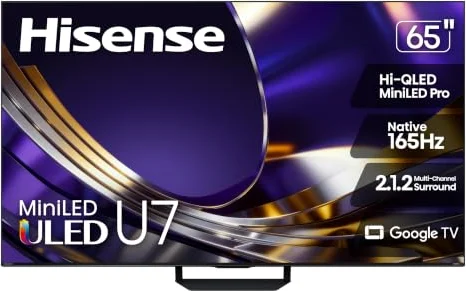
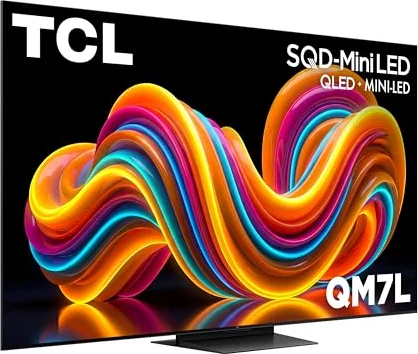
Full Specs Comparison
| Feature | Hisense 65" U7 Mini-LED ULED 4K Google TV (65U7SG, 2026) | TCL 65" QM7L SQD-Mini LED 4K Google TV (2026) |
|---|---|---|
| Price Band | Flagship | Flagship |
| Screen Size | 65" | 65" |
| Panel Type | Mini-LED (VA, matte) | SQD-Mini LED (VA) |
| Resolution | 4K UHD | 4K UHD |
| Refresh Rate | 165Hz | 144Hz |
| HDR Formats | Dolby Vision IQ, HDR10+, HDR10, HLG | Dolby Vision IQ, HDR10+, HDR10, HLG |
| Smart Platform | Google TV | Google TV |
| Check Price | Check Price |
Brightness: the U7 figure is the 65-inch; the QM7L figure is the 75-inch, from the same lab (Tom's Guide and TechRadar share it), because no 65-inch QM7L figure has been published.
Head to Head
Bright Rooms and Glare U7 Wins
This is the clearest difference. The 2026 U7 switched to a matte anti-glare screen, and RTINGS says its coating "nearly eliminates direct reflections". The QM7L has a glossy screen: CGMagazine, Digital Trends and T3 all found it reflective, despite TCL's anti-reflection claim. If a window or lamp faces your TV, the U7 is the better choice.
Peak Brightness U7 Wins
In the lab Tom's Guide and TechRadar share, the 65-inch U7 measured about 2,870 nits on a 10% HDR window in Filmmaker Mode, against about 2,270 nits for the 75-inch QM7L. The sizes differ, but the gap is large enough to favour the U7. Both are very bright for the money.
Colour QM7L Wins
The QM7L's new SQD quantum dots covered about 90% of the Rec.2020 colour range in the same lab, against about 83% for the U7. Tom's Guide credits the QM7L with "punchier" colour. Out-of-box accuracy is another matter: RTINGS rates the U7 more accurate before calibration, and RTINGS and Digital Trends both found the QM7L's HDR overbright out of the box.
Contrast and Black Levels Leans QM7L
The QM7L has more zones at 65 inches (1,152 against 960, per the makers). Tom's Guide found it delivered tighter contrast and that the U7 "crushes" near-black shadow detail in some HDR scenes; its U7 review called the black levels weak. RTINGS disagrees, praising the U7's deep blacks with very little haloing. With the labs split, we lean to the QM7L on the strength of its zone count and Tom's Guide's side-by-side test.
Gaming U7 Wins
The U7 has four full HDMI 2.1 ports and a 165Hz panel (VRR from 48 to 165Hz). The QM7L has two HDMI 2.1 ports at up to 144Hz, with its other two ports limited to 4K/60Hz; its soundbar connection sits on a slow port, so both fast ports stay free. Input lag is about the same: 9.8ms on the U7 and 9.4ms on the QM7L. With one console it is a draw; with a PS5, an Xbox and a PC, it is the U7.
Motion and Viewing Angles No Clear Winner
RTINGS found the U7's motion blurry, with a noticeable dirty screen effect and a narrow viewing angle, yet still rates its motion clearer than the QM7L's in a direct comparison. Reviewers found the QM7L loses colour off-axis and shows slight blooming from the side. Neither suits a wide seating arrangement especially well.
Sound and Extras U7 Wins
The U7 has a 50W 2.1.2 system with a built-in subwoofer, Wi-Fi 6E, an ATSC 3.0 tuner and a two-year US warranty on Hisense's spec sheet. The QM7L has 2.2-channel Bang & Olufsen speakers that reviewers found light on bass, Wi-Fi 5, and a disputed tuner (Digital Trends and CGMagazine report ATSC 1.0). Both run Google TV with Gemini.
Price Check Both
At the prices in our catalogue, the Hisense 65" U7 (2026) is modestly more expensive than the TCL 65" QM7L. Prices on both move often in sale season, so compare them on the day.
Who Should Get Which?
Get the Hisense U7 if...
- Your room is bright, or windows and lamps face the screen (see our best TVs for bright rooms)
- You connect three or four HDMI 2.1 devices, or game on a PC above 144Hz (see best TVs for gaming)
- You want stronger built-in sound and an ATSC 3.0 tuner
Get the TCL QM7L if...
- You watch mostly in a dim or mixed-light room
- Colour richness and contrast matter more to you than glare handling (see our best TVs for movies)
- You have one or two consoles, so two fast HDMI ports are enough
Frequently Asked Questions
Which is better, the Hisense U7 or the TCL QM7L?
The labs split. Tom's Guide tested both and scored them level (89 out of 100 each), but picked the QM7L for picture: punchier colour and tighter contrast. RTINGS rates the U7 "a bit better overall", citing its matte screen, upscaling, out-of-box accuracy and motion. The practical answer: the U7 for bright rooms and lots of gaming devices, the QM7L for colour and contrast in a dimmer room.
Which is better in a bright room?
The Hisense U7. Its new matte screen "nearly eliminates direct reflections" according to RTINGS, and it measured very bright (about 2,870 nits on a 10% HDR window). Reviewers found the QM7L's screen glossy and reflective despite TCL's anti-reflection claim.
Which is better for gaming?
The U7 has the better connections: four full HDMI 2.1 ports and a 165Hz panel, against two HDMI 2.1 ports and 144Hz on the QM7L. Input lag is similar (about 9.8ms on the U7 and 9.4ms on the QM7L in the same lab). With one console, either works well; with several consoles or a gaming PC, the U7's extra ports matter.
Which has more dimming zones?
The QM7L: TCL gives 1,152 zones for the 65-inch, against 960 for the 65-inch U7 (Hisense). Ignore the "up to 3,000" and "up to 2,100" figures on Amazon listings; those are the maximums for the biggest sizes.
Which has better built-in sound?
On paper, the U7: a 50W 2.1.2 system with a built-in subwoofer, which Tom's Guide called powerful. TechRadar was less impressed by its bass. The QM7L's 2.2-channel Bang & Olufsen speakers were described as limited in bass (TechRadar) and "merely ok" (Digital Trends). Most buyers at this level will add a soundbar to either.
Ready to Buy?
Also Compare
Still Deciding?
Sources
This comparison is based on the manufacturers' published specifications and on reviews and lab measurements by the outlets below. We have not tested either TV ourselves; where a figure comes from a specific reviewer, it says so. Tom's Guide and TechRadar share one test lab, so their identical measurements count as one source.
- Hisense USA, 65U7SG spec sheet
- TCL 2026 TV line-up press release (via LEDinside)
- Tom's Guide, Hisense U7SG vs TCL QM7L face-off
- RTINGS, TCL QM7L vs Hisense U7SG comparison
- RTINGS, Hisense U7SG review (65")
- RTINGS, TCL QM7L review (65")
- Tom's Guide, Hisense U7SG review (65")
- TechRadar, Hisense U7SG review (65")
- Tom's Guide, TCL QM7L review (75")
- Digital Trends, TCL QM7L review (85")
- CGMagazine, TCL QM7L review (65")