LG 55" OLED evo G5 Gallery Smart TV (2025) Review 2026
The first consumer Tandem OLED. Two stacked emissive layers double the brightness to ~1800 nits while keeping OLED's perfect blacks. The future of TV technology, flush-mounted on your wall.
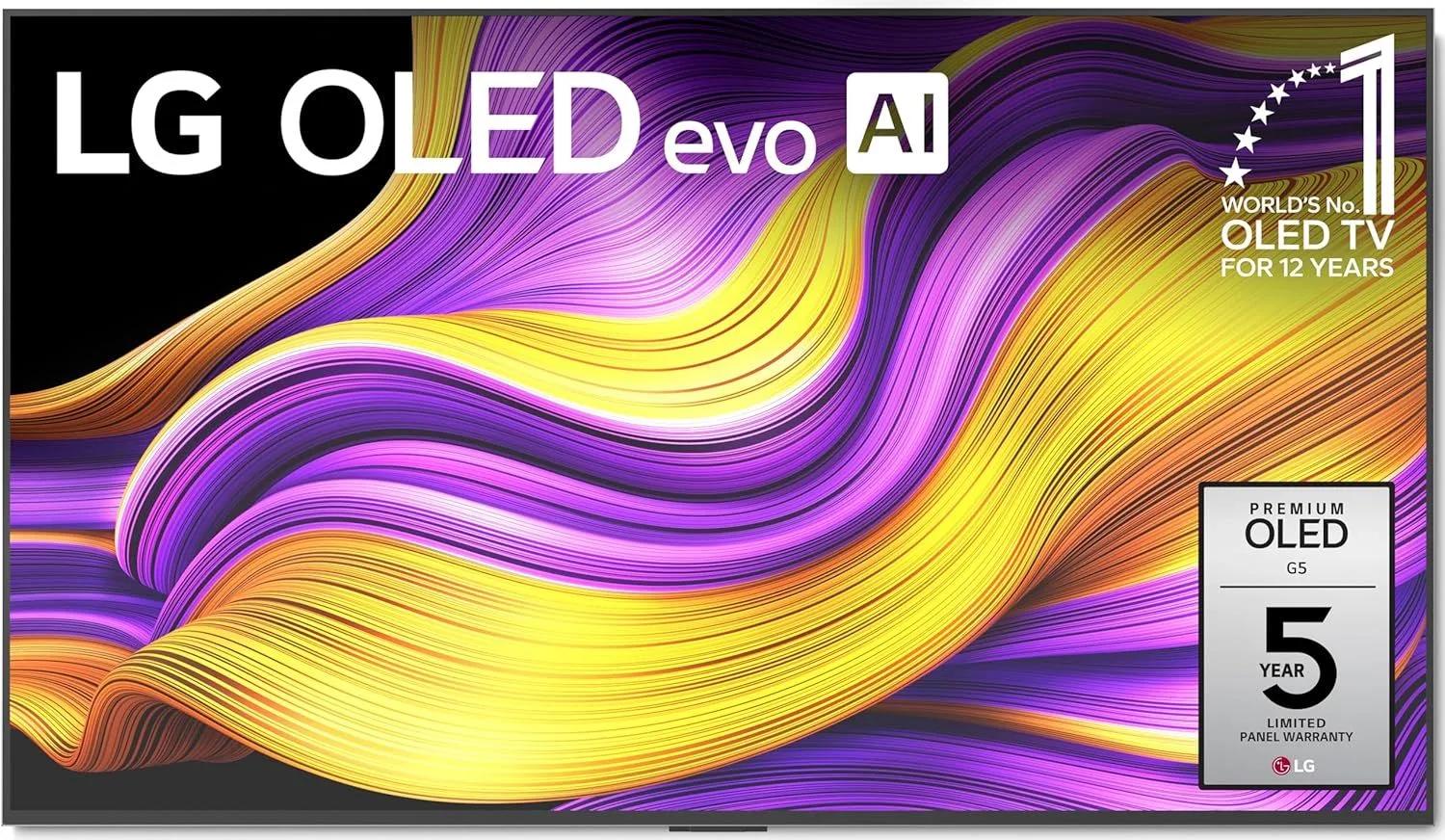
The G5 is the future of OLED — tandem technology doubles brightness while maintaining per-pixel contrast. If you're wall-mounting and want the absolute best OLED picture, this is it.
Two Layers of Light
Standard OLED uses one emissive layer per pixel. The G5 stacks two. Each pixel produces substantially more light than a single-layer C-series panel -- hitting approximately 1800 nits of peak brightness. This is not an incremental improvement. It is a generational leap that addresses OLED's primary weakness: brightness in ambient light.
HDR highlights on the G5 have an intensity that standard OLED cannot match. Sunlit scenes, metallic reflections, and fire sequences pop with a physicality closer to Mini-LED flagships. But unlike Mini-LED, the G5 maintains per-pixel perfect blacks with zero blooming. It is the best of both worlds -- and the first consumer TV to offer that combination.
Gallery Design: Built for the Wall
The G5 is not designed to sit on a media console. The Gallery Design is a wall-mount-first product with an included flush bracket. Mounted on a wall, the panel sits nearly flat against the surface with minimal gap. The ultra-slim profile makes it look more like a framed photograph than a television.
The anti-reflection coating reduces ambient reflections to near-invisible levels. Combined with the Tandem brightness, the G5 remains watchable in rooms where other OLEDs would wash out. This is the TV for modern open-plan living spaces where the TV is a design element, not just a screen.
The G5 packs a 60W speaker system -- 50% more power than the C-series' 40W. The larger driver array delivers better bass extension and clearer dialogue without a soundbar. For a wall-mounted setup where a soundbar disrupts the clean aesthetic, the G5's built-in audio is a real advantage.
Strengths
- ✓Tandem OLED doubles light output — brightest OLED available
- ✓Gallery Design mounts perfectly flush to walls
- ✓Reference-level color reproduction and anti-reflection
Cons
- ✗No stand included — wall-mount only unless bought separately
- ✗First-gen tandem OLED in consumer TVs
- ✗Significant premium over C5 for brightness gains
G5 vs C6: The Honest Assessment
The G5 costs modestly more expensive the LG C6, the 2026 C-series model that replaced the C5. For that premium, you get: a brighter tandem panel (around 1,800 nits, where TechRadar measured the C6 at about 1,430), Gallery Design with flush wall mount, a 60W speaker system (vs 40W), and the anti-reflection coating the C6 lacks. You do not get a larger screen.
The brightness difference is visible in any room with ambient light. In a dim home theater, the extra nits matter less -- infinite contrast from perfect blacks already delivers stunning HDR impact at around 1,400 nits. The G5 justifies itself in moderately to brightly lit rooms where that extra headroom, and its anti-reflection coating, keep OLED competitive with Mini-LED.
Frequently Asked Questions
What is Tandem OLED and why does it matter?
Tandem OLED stacks two OLED emissive layers instead of one. Each pixel has double the light-producing material. The result: substantially more brightness (around 1,800 nits, where reviewers measured the single-layer 2025 C5 at about 1,170) while maintaining perfect per-pixel black levels. It is the biggest OLED advancement since LG introduced WOLED.
Does the G5 come with a stand?
No. The Gallery Design is intended for wall mounting. A stand is sold separately. If you plan to place the TV on a media console, factor in the stand cost. The wall-mount bracket is included and installs flush.
Is the G5 worth the premium over the C6?
For wall-mount installations in rooms with moderate ambient light, yes. The extra brightness and the anti-reflection coating make HDR highlights more impactful, where the C6's glossy screen reflects lamps and windows. For dark room viewing or console-on-media-center setups, the C6 delivers the core OLED experience for less.
Is Tandem OLED a first-gen technology risk?
LG has manufactured Tandem OLED panels for commercial displays for several years. The G5 is the first consumer implementation. While consumer usage patterns differ, the underlying technology is not untested. LG offers standard manufacturer warranty coverage.
How does 1800 nits compare to Mini-LED brightness?
The G5 at ~1800 nits approaches many Mini-LEDs in peak brightness while maintaining OLED's perfect blacks and zero blooming. The brightest Mini-LEDs go much further (the 75-inch TCL QM8L measured about 3,720 nits on a 10% HDR window in the lab shared by Tom's Guide and TechRadar) but cannot match OLED black levels. The G5 offers the best of both worlds -- at a premium price.
Final Verdict
The G5 is the future of OLED — tandem technology doubles brightness while maintaining per-pixel contrast. If you're wall-mounting and want the absolute best OLED picture, this is it.
The absolute best OLED picture available. Tandem technology closes the brightness gap with Mini-LED while keeping perfect blacks. Buy it for a wall-mounted statement piece in a well-lit room.
See all Best OLED TVs