Hisense 65" U7 Mini-LED ULED 4K Google TV (65U7SG, 2026) Review 2026
The 2026 U7 is Hisense's mainstream Mini-LED and the successor to the U75QG. Its strengths are easy to state: it is very bright, its new matte screen deals with reflections, and all four HDMI ports are full HDMI 2.1 at up to 165Hz. Its weaknesses are motion blur, a narrow viewing angle, and reviewers who cannot agree on how good its blacks are.
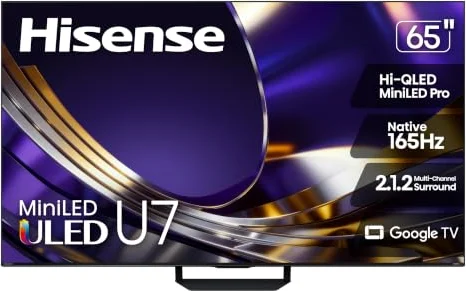
The 2026 U7 is the bright-room, gaming-first Mini-LED: very high measured brightness, a new matte screen and four HDMI 2.1 ports at 165Hz. Motion blur, a narrow viewing angle and split verdicts on black levels keep it from being a clear-cut pick over the TCL QM7L.
What Changed From the U75QG
Hisense's US spec sheets for the 65-inch U75QG (2025) and 65-inch U7SG (2026) show a careful update rather than a new TV. One point to clear up first: the refresh rate did not change. The U75QG was already a native 165Hz panel, and so is the new model. The real changes are:
- A matte screen. RTINGS describes the old U75QG as glossy and the new U7 as matte, with a coating that "nearly eliminates direct reflections". This is the most useful change for most rooms.
- A faster low-resolution game mode: Game Booster now reaches 330Hz at lower resolutions, up from 288Hz.
- Sound tuned by Devialet, with DTS Virtual:X added to the same 50W 2.1.2-channel system.
- A slimmer, lighter body (2.3 inches deep, down from 3.0) and a pedestal stand with two height positions.
Carried over: four HDMI 2.1 ports, Wi-Fi 6E, an ATSC 3.0 (NextGen TV) tuner, Dolby Vision and HDR10+, and a two-year US warranty. Tom's Guide notes the launch price was comparable to the U75QG's. Hisense also sells a Fire TV version, the U7SF, with the same listed hardware.
Brightness and Zones: Read the Small Print
Retail listings for the U7 advertise "up to 3000 local dimming zones" and "up to 3000 nits". Those are series maximums. Hisense's own product pages list 960 zones for the 65-inch model, and the 55-inch is rated at up to 2,000 nits rather than 3,000.
The measured brightness is still exceptional. Tom's Guide and TechRadar, which share a test lab, recorded about 2,870 nits on a 10% HDR window in Filmmaker Mode and close to 800 nits across a full white screen. RTINGS, testing its own 65-inch set, calls the peak brightness "fantastic". That is roughly double what the best OLEDs reach on small highlights, and far more on bright, full-screen scenes.
Picture Quality: Where Reviewers Disagree
On black levels and contrast, the reviews split, and we can't resolve it from the published evidence. RTINGS found "excellent black levels" with "very little haloing" around bright objects. Tom's Guide, testing the same size, found "weak black levels" and a screen that "never got as dark as it should", with shadows either too bright or crushed. Its head-to-head with the TCL QM7L noted the U7's "tendency to crush near-black shadow detail". Different samples or settings may explain the gap.
Other weaknesses are agreed. RTINGS reports a narrow viewing angle, a "very distracting dirty screen effect" (uneven patches that show on large areas of a single colour), slow response with blurry motion, and some banding. TechRadar saw "some minor vignetting and color bleeding". Colour is decent rather than class-leading: the shared Tom's Guide and TechRadar lab measured an average colour error (Delta E) of about 3.0 in Filmmaker Mode, against 2.6 for the TCL QM7L.
The U7's VA panel loses contrast and colour when viewed from the side, according to RTINGS. If your seating is spread wide, put the most-used seat as close to the centre line as you can.
Gaming: Four Full HDMI 2.1 Ports
This is where the U7 stands out at its price. All four HDMI ports carry full HDMI 2.1 bandwidth (RTINGS confirms it on all four), so a PS5, an Xbox Series X and a gaming PC can stay plugged in at once. It runs 4K at up to 165Hz with VRR from 48Hz, supports FreeSync Premium Pro, ALLM, Dolby Vision gaming and HDR10+ gaming, and has a Game Bar overlay. The shared Tom's Guide and TechRadar lab measured input lag of 9.8ms, and RTINGS calls it "extremely low".
The catch for fast games is the same motion blur that affects sports. See our gaming TV guide and HDMI 2.1 explained for what these features mean in practice.
Sound, Google TV and the Details
The 2.1.2-channel, 50W speaker system with a built-in subwoofer is better than most TVs offer, but the reviewers hear it differently. Tom's Guide called it "powerful" and suggested you could skip a soundbar; TechRadar found the bass "mostly missing" but still thought it good enough to skip a cheap soundbar.
Google TV now includes hands-free Gemini voice search, which TechRadar found inconsistent. Tom's Guide flagged privacy defaults worth reviewing during setup and a chunky remote. Other details: Wi-Fi 6E, an ATSC 3.0 tuner, VESA 400 x 300 mounting, about 43 pounds without the stand, and no headphone jack.
Strengths
- ✓Very bright: about 2,870 nits on a 10% HDR window in Tom's Guide and TechRadar's shared lab tests
- ✓Four HDMI 2.1 ports, native 165Hz and very low input lag (9.8ms)
- ✓New matte anti-glare screen (RTINGS: it nearly eliminates direct reflections)
Cons
- ✗Narrow viewing angle and blurry motion (RTINGS)
- ✗Reviewers disagree on black levels: RTINGS praises them, Tom's Guide found them weak
- ✗960 dimming zones at 65", not the "up to 3,000" in retail listings
What Owners Report
Owner discussions on Reddit (r/Hisense, r/4kTV and r/hometheater, June to October 2026) are mostly positive. Owners praise the brightness, the HDR and the matte screen in daytime rooms; one called it "perfect" for the price. One owner who bought both the U7 and a TCL QM6K said the Hisense handled sports much better, which differs from RTINGS's finding of motion blur; another owner of the 100-inch model reported no ghosting in shooters.
The complaints echo RTINGS on some points. One owner returned two units over a dirty panel (uneven patches) and dead pixels, and a 75-inch owner found 4K excellent but 720p broadcasts poor. A 65-inch owner reported HDMI connections to an AV receiver dropping. One owner of the 100-inch model described its screen as glossy; RTINGS tested the 65-inch and found it matte, so that may be a size difference. These are individual reports, not a defect rate, so check a new panel on a few plain-colour images while you can return it.
What the Reviews Say
Scores are good but not unanimous: 4 out of 5 from TechRadar, which called it "one of the best TVs out there purely in terms of value", 3.5 out of 5 from Tom's Guide, which liked the sound and gaming features but not the blacks or HDR, and 8.3 from RTINGS, which rates it a strong all-rounder for bright rooms.
U7 vs the Alternatives
- TCL QM7L (65"): Tom's Guide scored the two level and found the QM7L the better performer for colour and upscaling (it covered about 90% of Rec.2020 against the U7's 83%). The U7 wins on brightness (about 2,870 against 2,270 nits in the same lab) and connections (four HDMI 2.1 ports and 165Hz against two ports and 144Hz).
- Hisense 65" U6 Pro: also matte, about half as bright in the same lab (around 1,265 nits), and only two HDMI 2.1 ports. TechRadar called the U7 "a slightly better TV" for not much more money.
- Samsung QN70H: RTINGS found it edge-lit, 60Hz, without HDMI 2.1, VRR or Dolby Vision. On paper the U7 is far more capable.
- Hisense U75QG: last year's model, with the same 165Hz panel rating and ports, but a glossy screen.
Who Should Buy the U7, and Who Shouldn't
Buy it if your room is bright, you game on more than one console or a PC, or you want built-in sound that can do without a cheap soundbar. It is one of the brightest TVs at its price.
Look elsewhere if your seating is spread wide, you watch a lot of fast sport and dislike motion blur, or picture finesse matters more than brightness and ports: the TCL QM7L is the evidence-backed alternative there.
Frequently Asked Questions
What changed from the Hisense U75QG to the 2026 U7?
Less than the marketing suggests. Comparing Hisense's two US spec sheets, the refresh rate is unchanged (the U75QG was already native 165Hz). The main changes are a matte anti-reflective screen in place of the old glossy one, a faster lower-resolution game mode (330Hz instead of 288Hz), Devialet sound tuning, a slimmer body and a height-adjustable stand. Four HDMI 2.1 ports, Wi-Fi 6E, the ATSC 3.0 tuner and the two-year US warranty carry over.
How many dimming zones does the 65-inch U7 have?
960. Retail listings say "up to 3000 local dimming zones", but that figure is the maximum across the series. Hisense lists 512 zones for the 55-inch, 960 for the 65-inch, 1,100 for the 75-inch, 1,536 for the 85-inch and 2,304 for the 100-inch.
Is the U7SG different from the U7SF?
Only in software and price, as far as the spec sheets show. The U7SG runs Google TV and the U7SF runs Fire TV with Alexa; zones, refresh rate, ports, speakers, size and weight are listed as identical. RTINGS describes the U7SF as the same TV with the Fire TV interface, though no outlet has reviewed the Fire TV version separately.
Is the Hisense U7 good for a bright room?
Yes, it is one of its strengths. Tom's Guide and TechRadar's shared lab measured about 2,870 nits on a 10% HDR window, and RTINGS says the new matte coating "nearly eliminates direct reflections".
Should I buy the Hisense U7 or the TCL QM7L?
Tom's Guide tested both at 65 inches and scored them level (89 out of 100 each). It found the QM7L the better performer for colour and upscaling, while the U7 wins on connections: four HDMI 2.1 ports and 165Hz against the QM7L's two ports and 144Hz. Gamers with several consoles or a PC lean U7; picture-first buyers lean QM7L.
Final Verdict
The 2026 U7 is the bright-room, gaming-first Mini-LED: very high measured brightness, a new matte screen and four HDMI 2.1 ports at 165Hz. Motion blur, a narrow viewing angle and split verdicts on black levels keep it from being a clear-cut pick over the TCL QM7L.
For a bright living room with a console or two, the U7 delivers more brightness and more full-speed ports than almost anything near its price. Check the viewing angle against your seating before you buy.
Sources
This review is based on the manufacturer's published specifications, on reviews and lab measurements by the outlets below, and on owner reports. We have not tested the TV ourselves; where a figure comes from a specific reviewer, it says so. Tom's Guide and TechRadar share a test lab, so their measurements count as one set of figures.
- Hisense USA, 65U7SG specification sheet
- Hisense USA, 65U75QG specification sheet (2025 predecessor)
- Hisense, 65U7SF (Fire TV version) specification sheet
- Hisense Canada, 65U7SG product page (zone count)
- RTINGS, Hisense U7SG review (65")
- Tom's Guide, Hisense U7SG review, Sean Captain (65")
- TechRadar, Hisense U7SG review, James Holland (65")
- Tom's Guide, Hisense U7SG vs TCL QM7L face-off
- RTINGS, Hisense U75QG review (predecessor)
- Reddit r/Hisense, "Hisense U7SG concerns before buying" owner thread (June 2026)
- Reddit r/4kTV, U7SG standard-definition content thread (September 2026)