TCL 75" QM8K QD-Mini LED Premium 144Hz Smart TV Review 2026
TCL's 2025 flagship: Halo Control blooming reduction, 144Hz gaming, and 2500 nits at 75 inches. The most advanced Mini-LED from the brand that made Mini-LED affordable.
No longer sold. The TCL 75" QM8K has been replaced by the TCL 75" QM8L SQD-Mini LED 4K Google TV (2026). This review stays here as a record of the TCL 75" QM8K for anyone who owns one or is comparing models.
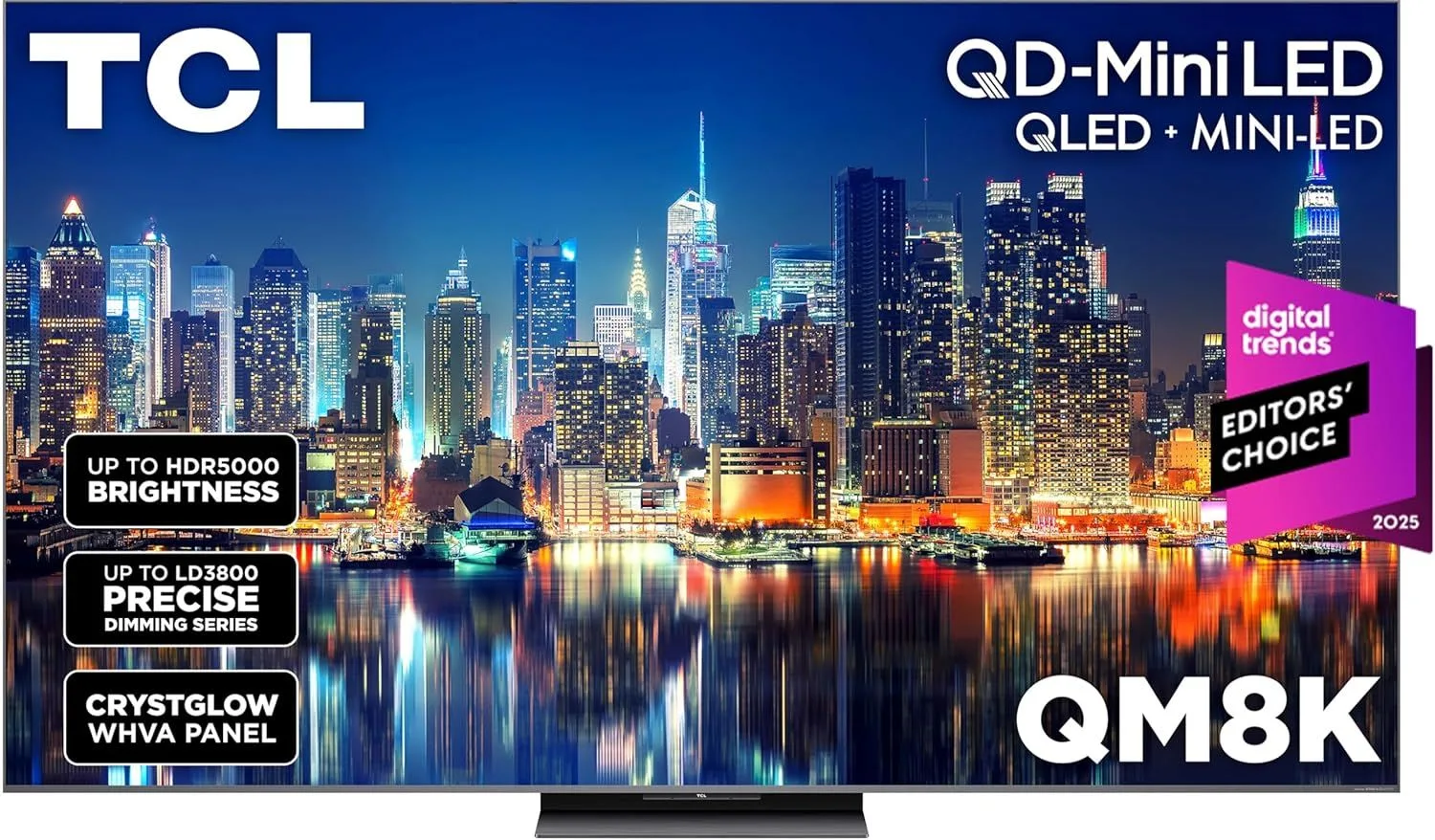
TCL's QM8K is the most advanced Mini-LED at 75". The Halo Control System genuinely reduces blooming, and 144Hz with VRR covers gaming. The flagship TCL that competes with Sony.
The Flagship TCL
TCL built its reputation on value -- delivering more specs per dollar than Samsung and Sony. The QM8K is something different. At a Flagship price, this is TCL's first TV that competes on technology rather than price. Halo Control is a proprietary blooming reduction system. It runs at up to 144Hz with VRR. The AIPQ PRO 2.0 processor represents TCL's most advanced image processing.
The question is no longer "is TCL good for the price?" It is "can TCL compete with Sony and Samsung at the flagship level?" On picture performance, yes. On processing refinement and brand confidence, the gap has narrowed but remains.
Halo Control: Solving Mini-LED's Biggest Problem
Every Mini-LED TV has the same weakness: blooming. Bright objects on dark backgrounds bleed light into surrounding zones, creating visible halos. The fewer zones, the worse the effect. Even 1000-zone panels show it in challenging content.
TCL's Halo Control System addresses this with predictive algorithms that adjust zone brightness based on content analysis. The result: measurably less blooming than the QM6K and QM7K in independent testing. Subtitles on black bars show tighter halos. Movie credits float more cleanly on dark backgrounds. Bright stars on night skies have smaller bloom radii.
Blooming is reduced, not eliminated. OLED remains the only technology with zero bloom. But Halo Control is the biggest Mini-LED improvement since the technology went mainstream.
Connect a gaming PC or current console via HDMI 2.1 to use the full 144Hz with VRR. Console gamers cap at 120fps; PC gamers get the extra headroom.
Strengths
- ✓Halo Control System reduces Mini-LED blooming
- ✓144Hz gaming with VRR
- ✓AIPQ PRO 2.0 processor with excellent HDR
Cons
- ✗Premium pricing for TCL brand
- ✗New model with limited long-term data
- ✗Blooming reduced but not eliminated
2500 Nits at 75 Inches
Roughly 2500 nits of peak brightness on a 75-inch panel is staggering. HDR highlights do not just pop -- they demand attention. Sunlit scenes, explosions, metallic surfaces, and fire all render with an intensity that makes the room brighter. In a well-lit living room, the QM8K maintains full HDR impact where lesser panels wash out.
The brightness also helps in the QM8K's Achilles' heel scenario: dark content in a dark room. High peak brightness allows brighter bright objects to coexist with dimmer zones more effectively, and Halo Control keeps the surrounding zones tighter. The result is the best dark-room Mini-LED performance available at 75 inches.
The QM6K Question
The TCL 75" QM6K costs roughly double the price while delivering solid Mini-LED performance at 144Hz. For many buyers, the QM6K is the smarter purchase. The QM8K justifies itself for dark-room viewing (Halo Control), and HDR-heavy content (2500 nits). If your viewing is primarily bright, colorful streaming content, the QM6K handles that excellently at a much lower price.
The Samsung QN90F Alternative
The other flagship 75-inch Mini-LED worth considering is the Samsung QN90F. It trades raw brightness (2000 nits vs the QM8K's 2500) for the industry's best anti-reflection coating and 60W Object Tracking Sound+. See our full TCL QM8K vs Samsung QN90F comparison for the detailed head-to-head.
Frequently Asked Questions
What is Halo Control and does it actually reduce blooming?
Halo Control is TCL's proprietary algorithm that adjusts backlight zones based on content analysis to minimize light bleed around bright objects on dark backgrounds. Independent testing confirms it reduces visible blooming compared to previous TCL models. It does not eliminate blooming entirely -- no Mini-LED does -- but the improvement is measurable.
What refresh rate does the 75" QM8K have?
Up to 144Hz with VRR and ALLM, per TCL's Amazon listing (120Hz to 144Hz). That is plenty for PS5 and Xbox Series X, which cap at 120fps, and smooth for PC gaming
How does the TCL 75" QM8K compare to an OLED?
At 2500 nits, the QM8K significantly outbrights any OLED in HDR highlights. In a bright room, the QM8K is the clear winner. In a dark room, OLED still delivers superior black levels and zero blooming. The QM8K narrows that gap with Halo Control but does not close it. At 75 inches, no OLED exists at this price.
Is the TCL QM8K worth the upgrade from the QM6K?
If you watch a lot of dark content (prestige TV, horror, sci-fi) or game competitively, the Halo Control and higher brightness justify the price gap. For bright, colorful content and casual streaming, the QM6K delivers 85% of the experience at a significantly lower price.
Is TCL reliable enough for a flagship TV purchase?
TCL is the third-largest TV manufacturer globally. Their entry and mid-range TVs have extensive track records. The QM8K is their newest flagship with limited long-term data, but TCL's manufacturing quality has improved consistently. Standard manufacturer warranty applies.
Final Verdict
TCL's QM8K is the most advanced Mini-LED at 75". The Halo Control System genuinely reduces blooming, and 144Hz with VRR covers gaming. The flagship TCL that competes with Sony.
Buy it for the most advanced Mini-LED technology at 75 inches -- Halo Control and 2500-nit brightness are the standouts. Skip it if the QM6K's performance is sufficient for your viewing habits at a much lower price.