TCL 65" QM7L SQD-Mini LED 4K Google TV (2026) Review 2026
The QM7L is TCL's 2026 mid-range Mini-LED and the successor to the QM7K. Its headline change is colour: TCL's new Super Quantum Dot system pushes it close to the colour volume of far pricier TVs, and labs measured it brighter too. It keeps the QM7K's weak spots: only two full-speed HDMI ports, a glossy screen, and HDR that is overcooked out of the box.
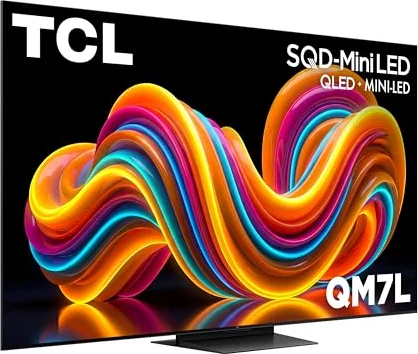
The QM7L is the mid-range Mini-LED to beat for colour and brightness: reviewers measured it brighter and far more colourful than the QM7K. Its limits are two fast HDMI ports, a reflective screen and HDR that needs taming.
What Changed From the QM7K
Reviewers and RTINGS agree the QM7L is "a bit better than the QM7K overall". The gains are in colour and brightness; some other things stayed the same or slipped.
- Much wider colour. "SQD-Mini LED" means single-colour Mini-LEDs behind an improved quantum-dot layer and a new colour filter. The Future lab that tests for Tom's Guide and TechRadar measured about 90% of the Rec.2020 colour space on the QM7L, up from about 79% on the 65-inch QM7K. TCL markets "100% BT.2020"; no lab has measured that.
- Brighter. The same lab measured about 2,270 nits on a 10% HDR window in Filmmaker Mode on the 75-inch QM7L, against about 1,730 on the 65-inch QM7K. The sizes differ, so read it as a direction rather than an exact gap. Digital Trends saw a similar jump.
- New backlight control. A 26-bit controller and what TCL calls its Enhanced Halo Control System, aimed at blooming.
- HDMI is unchanged: still two full HDMI 2.1 ports.
- Accuracy went backwards. Digital Trends measured an SDR colour error of 2.6 against 0.8 on the QM7K, and RTINGS says the QM7L "overbrightens HDR content" much more than its predecessor.
- The zone claim on the box went down. The QM7K was marketed with "up to 2,800" zones and the QM7L with "up to 2,100". Both are series maximums from the largest size; TCL did not publish per-size QM7K counts, so a like-for-like 65-inch comparison isn't possible.
The QM7K is still covered in our TCL 65" QM7K review.
Picture: Colour and Punch First
The 65-inch QM7L has 1,152 local dimming zones and a 3,000-nit brightness claim, per TCL's per-size figures (the bigger numbers on the Amazon listing belong to the 98-inch). There is no published lab brightness figure for the 65-inch yet: RTINGS tested it, but its measurements are for members only. The closest numbers are the Future lab's from the 75-inch: about 2,270 nits on a 10% HDR window and over 700 nits across a full white screen, both in Filmmaker Mode. Digital Trends measured about 2,800 nits on the 85-inch.
Reviewers like what that brightness and colour do to HDR. Tom's Guide called it "bright, colorful, and accurate out of the box" and later named it its top Mini-LED TV of 2026; CGMagazine, testing the 65-inch, praised "searing brightness, near-OLED black levels"; T3, testing the European 65-inch C7L, gave it five stars for "endlessly watchable, high-contrast HDR". TechRadar judged its picture to be about "97% of what one gets with the QM8L".
The dissent is about accuracy. RTINGS flags HDR as very inaccurate and overbright, and Digital Trends wrote that "HDR accuracy out of the box could be better". Tom's Guide's lab was more forgiving in Filmmaker Mode (an average colour error of about 2.6), so the picture mode you pick matters. Blooming is well controlled from the centre seat, but Tom's Guide noted "slight off-angle light blooming", and VA-panel colour fades from the sides (CGMagazine, T3).
Start in Filmmaker Mode, where the Future lab measured the most accurate results. If HDR still looks too bright or too saturated, that matches what RTINGS and Digital Trends found in other modes; a calibration or a more conservative preset will rein it in.
The Catch: A Glossy Screen
TCL says the HVA 2.0 Pro panel has an anti-reflection layer. Reviewers don't see much of it: CGMagazine called the screen "glossy rather than matte", T3 found it reflective, and Digital Trends agreed. RTINGS rates the QM7L slightly better than the QM8L with direct reflections, but says neither excels. The brightness does help it stay watchable in daylight (Digital Trends called it bright enough for a sunlit room), but lamps and windows opposite the screen will show. RTINGS rates the matte-screened 2026 Hisense U7 better for reflections. For more options, see our best TVs for bright rooms.
Gaming: Great for One Console
The QM7L runs 4K at up to 144Hz and 1080p at up to 288Hz, with VRR (AMD FreeSync Premium Pro), ALLM, HGiG and TCL's Game Bar overlay. The Future lab measured about 9.4ms input lag on the 75-inch, and Digital Trends about 10ms.
The limit is ports. Only HDMI 1 and 2 handle 4K at 120 or 144Hz; HDMI 3 and 4 stop at 4K/60. The eARC soundbar connection is on HDMI 4, so it doesn't use up a fast port, which is a sensible layout. A PS5 and an Xbox fit; add a gaming PC and you will be swapping cables. The QM8L has four full-speed ports. TCL does not publish the VRR range for the QM7L, and Dolby Vision gaming on the US model is unconfirmed. More background in our gaming TV guide and HDMI 2.1 explainer.
Sound, Smart Features and the Details
Audio is a 2.2-channel system tuned by Bang & Olufsen, with two down-firing drivers and two rear woofers, Dolby Atmos and DTS:X; TCL hasn't published US wattage. Reviewers split: Tom's Guide said you don't need a soundbar, Digital Trends called the sound "merely ok", and TechRadar and T3 found it light on bass.
- Google TV with Gemini. TCL gives no timeframe for OS updates.
- HDR formats: Dolby Vision IQ, HDR10+, HDR10, HLG and IMAX Enhanced. (Dolby Vision 2 Max is promised for the QM8L only.)
- Wi-Fi 5 and Bluetooth 5.4.
- Tuner: disputed. Digital Trends and CGMagazine say ATSC 1.0; TechRadar and Tom's Guide say ATSC 3.0. Treat NextGen TV support as unconfirmed.
- Stand: a centre pedestal with two height positions, so a soundbar can sit underneath. The 65-inch weighs about 40 pounds without it.
- Variant warning: Costco sells a "QM7L Pro" with four HDMI 2.1 ports. It is a different model; this review doesn't cover it.
Strengths
- ✓Very bright for its class (Future lab: about 2,270 nits on a 10% HDR window, 75" model)
- ✓SQD colour: about 90% Rec.2020 measured, up from about 79% on the QM7K
- ✓1,152 local dimming zones at 65" with strong blooming control head-on
Cons
- ✗Only two HDMI ports run 4K/144Hz (the other two are 4K/60)
- ✗Glossy screen reflects lamps and windows despite TCL's anti-reflection claim
- ✗HDR is overbright and inaccurate out of the box (RTINGS, Digital Trends)
What Owners Report
Owner discussions on Reddit (mainly r/tcltvs, plus r/RTINGS, July to October 2026) are mostly positive about the picture once it has been adjusted. Several 65-inch owners describe strong HDR, Dolby Vision and deep blacks, and one who has had the set for a few months called sports in 4K HDR "very good". The same owners also report the out-of-box tuning the labs criticised: a push towards red and a Filmmaker Mode that looked too dark to them, both fixed in the settings. One owner returned a QM7L over red-tinted skin tones in SDR that adjustments did not cure.
The other recurring themes are software and motion. More than one owner found the Google TV interface and apps slow, with occasional app crashes; one 65-inch owner said app updates later improved things. Motion splits owners: some see little blur or judder, especially with motion processing adjusted or an external streaming box, while one owner who upgraded from a 75-inch QM7K preferred the older set for sports and menu speed. One owner also mentioned rainbow-coloured reflections when light hits the screen. These are individual reports, not a defect rate, and they leave out the Costco-only QM7L Pro, which owners discuss as a separate model.
What the Reviews Say
Scores are high across the board: 4.5 out of 5 and an Editor's Choice from Tom's Guide, 4.5 from TechRadar (which named it its best mid-range TV), 8.5 out of 10 from CGMagazine, 8 from Digital Trends, and five stars from T3 for the European version. The consensus: very bright, near-QD-OLED colour, good blooming control for the money, a reflective screen, and only two fast HDMI ports. Reviewers differ on the speakers and on how accurate it is out of the box.
QM7L vs the Alternatives
- TCL 75" QM8L: the step up. Brighter (about 3,720 nits on the same lab's 75-inch test), better halo control, four full HDMI 2.1 ports, Wi-Fi 6 and a confirmed ATSC 3.0 tuner, with almost identical colour coverage. Tom's Guide still calls the QM7L the better pick for most people on price, and it comes in a 55-inch size; the QM8L starts at 65.
- Hisense U7 (2026): the closest rival, and reviewers split. Tom's Guide picked the QM7L for its punchier, tighter-contrast picture; RTINGS rates the U7 "a bit better overall" for its matte screen, accuracy, motion and higher refresh rate. The U7 also has four HDMI 2.1 ports.
- TCL 65" QM6K: the cheaper TCL Mini-LED. TechRadar calls it "much more limited", with lower peak brightness and worse sound, but it costs considerably less.
- Samsung QN70H: RTINGS says the QM7L is "much better": deeper blacks, much less haloing, better reflection handling and far higher brightness.
Who Should Buy the QM7L, and Who Shouldn't
Buy it if you want the most colour and HDR impact you can get at a mid-range price, you shop at 55 or 65 inches, and you game on one or two consoles.
Look elsewhere if you have three or more devices that need 4K/120 (consider the QM8L or the Hisense U7), lamps or windows face the screen (the U7's matte screen copes better), you want accurate HDR without adjusting settings, or you need a confirmed ATSC 3.0 tuner.
Frequently Asked Questions
What is the difference between the TCL QM7L and the QM7K?
The QM7L adds TCL's Super Quantum Dot (SQD) colour system and is brighter. In the Future lab used by Tom's Guide and TechRadar, colour coverage rose from about 79% of Rec.2020 (65" QM7K) to about 90% (75" QM7L), and 10% HDR brightness from about 1,730 to 2,270 nits (different sizes, so treat the gap as indicative). HDMI is unchanged at two full-speed ports. On paper the QM7K's headline zone claim was higher ("up to 2,800" against "up to 2,100"), but both figures are series maximums and per-size QM7K counts were not published.
How many dimming zones does the 65-inch QM7L have?
1,152, according to TCL's per-size figures (800 on the 55-inch, 1,352 on the 75-inch). The "up to 2,100+" zones on the Amazon listing is the 98-inch model.
Is the TCL QM7L good for PS5 and Xbox?
Yes, for one or two consoles. HDMI 1 and 2 run 4K at up to 144Hz with VRR (FreeSync Premium Pro) and ALLM, and the Future lab measured about 9.4ms input lag. HDMI 3 and 4 are limited to 4K/60, so a third high-frame-rate device needs the QM8L, which has four full-speed ports.
Does the QM7L have an anti-glare screen?
TCL says the panel has an anti-reflection layer, but reviewers describe it as glossy. CGMagazine called it "glossy rather than matte", and T3 and Digital Trends also found it reflective. Its brightness helps in a sunny room, but lamps or windows facing the screen will show.
Does the TCL QM7L have an ATSC 3.0 tuner?
Sources disagree. Digital Trends, which inspected the connections, lists ATSC 1.0, and CGMagazine says it lacks ATSC 3.0, while TechRadar and Tom's Guide list ATSC 3.0. We have not been able to confirm it from TCL's own spec page, so if over-the-air NextGen TV matters to you, treat it as unconfirmed. The QM8L does have ATSC 3.0.
Final Verdict
The QM7L is the mid-range Mini-LED to beat for colour and brightness: reviewers measured it brighter and far more colourful than the QM7K. Its limits are two fast HDMI ports, a reflective screen and HDR that needs taming.
For 65-inch buyers who want a big step up from an entry Mini-LED without paying flagship money, the QM7L is the strongest all-round pick of TCL's 2026 range. Plan around its two fast HDMI ports and its reflective screen.
Compare This TV
See how it stacks up in a detailed head-to-head.
Sources
This review is based on the manufacturer's published specifications, on reviews and lab measurements by the outlets below, and on owner reports. We have not tested the TV ourselves; where a figure comes from a specific reviewer, it says so. Tom's Guide and TechRadar share one test lab, so their identical measurements count as one source.
- TCL 2026 SQD-Mini LED line-up press release (reproduced by LEDinside)
- Tom's Guide, TCL QM7L review, Arif Bacchus (75")
- TechRadar, TCL QM7L review, James Holland
- Digital Trends, TCL QM7L review, Andre Revilla (85")
- CGMagazine, TCL QM7L review, Brendan Frye (65")
- T3, TCL C7L (European QM7L) review, Simon Lucas (65")
- What Hi-Fi?, TCL C7L hands-on (per-size zone and brightness figures)
- RTINGS, TCL QM7L review (65")
- RTINGS, TCL QM7K vs QM7L comparison
- RTINGS, TCL QM7L vs Hisense U7SG comparison
- Tom's Guide, Hisense U7SG vs TCL QM7L face-off
- Tom's Guide, Super Quantum Dot explainer
- Reddit r/tcltvs, "QM7L running much slower than QM7K" owner thread (October 2026)
- Reddit r/tcltvs, "So is the QM7L or Pro worth the hype?" owner thread (October 2026)