TCL 65" QM6K QD-Mini LED 144Hz Smart TV Review 2026
The most affordable way into 65" Mini-LED with 144Hz gaming. TCL compressed flagship-tier technology into a price point that makes most QLEDs look overpriced.
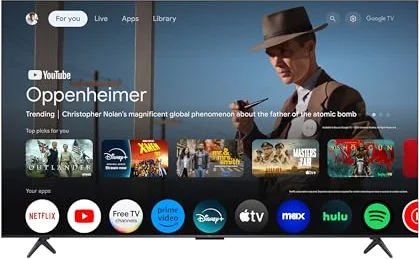
The 65" QM6K is the gateway to Mini-LED that doesn't break the bank. 144Hz gaming and real local dimming at a price that undercuts most 65" QLEDs; its HDR brightness is modest. Best value in the entire Mini-LED category.
The Price That Changed Mini-LED
Two years ago, a 65" Mini-LED TV with 144Hz cost north of a thousand dollars. TCL's QM6K delivers it at a Step-up price — less than most 65" QLEDs from Samsung and Sony. That is not an incremental improvement. It is a category shift.
The QM6K sits at the entry point of TCL's Mini-LED lineup. TCL's 2026 QM7L above it adds more than twice the zones and TCL's new SQD color. The QM8L above that pushes into flagship territory. But the QM6K is where the value calculation becomes almost unfair to the competition.
Brightness: Better Than Budget, Not a Showpiece
Tom's Guide measured about 695 nits on a 10% HDR window, on the 55-inch model (no 65-inch lab figure is public; RTINGS's numbers are member-only). That's modest for Mini-LED, and the reviewer noted HDR isn't a big step up from SDR (688 nits). Highlights still carry more punch than a budget LED, but for real HDR impact or a sunny room, the brighter Hisense U7 (about 2,870 nits in the same lab) is the step up.
With roughly 500 dimming zones at 65 inches, the local dimming handles most content well. Dark movie scenes maintain good black levels, and the transition between bright and dark elements within the same frame is controlled. Blooming shows up in challenging test patterns and in demanding content like white text on pure black — but in normal viewing, it rarely distracts.
Switch to the "Movie" picture preset for Dolby Vision content. TCL's default "HDR Vivid" mode oversaturates colors and crushes blacks. The Movie preset delivers more accurate tone mapping and better shadow detail — closer to what the content creators intended.
144Hz Gaming: The Real Differentiator
The 144Hz refresh rate, paired with VRR and two HDMI 2.1 ports, positions the QM6K as a serious gaming display. Input lag in Game Mode drops below 10ms — fast enough for competitive shooters, responsive enough for fighting games, and smooth enough for racing titles.
Dolby Vision gaming support gives Xbox Series X owners a real advantage. Games like Halo Infinite and Forza Motorsport in Dolby Vision look visibly better than standard HDR10 — richer colors, better highlight detail, more nuanced shadow rendering. This is a feature Samsung cannot match at any price.
What We Like
- ✓Most affordable 65" Mini-LED with 144Hz gaming
- ✓Real local dimming (up to 500 zones) at an entry price
- ✓Dolby Vision and HDR10+ with Google TV
Cons
- ✗Entry Mini-LED — fewer zones than QM7K and QM8K
- ✗Some blooming in dark content
- ✗Glossy screen reflects lamps and windows (RTINGS)
Google TV: Feature-Rich but Busy
TCL runs Google TV with Chromecast built in. The app selection is comprehensive, Google Assistant voice search works well, and casting from your phone is seamless. Content recommendations across streaming services are useful once the algorithm learns your preferences.
The interface is busier than Roku or Apple TV. Google promotes its own services, and the home screen mixes ads with genuine recommendations. It is a capable platform — just not a calm one.
Where It Fits in the Lineup
The QM6K undercuts its closest competitors by hundreds. Samsung's 65" QN70F costs significantly more for fewer zones and no Dolby Vision. Hisense's 2026 U6 Pro, which replaced the U65QF, adds an anti-glare screen and measured about 1,265 nits in Tom's Guide and TechRadar's shared lab, but costs considerably more. TCL's QM7L and Hisense's 2026 U7 offer better Mini-LED performance — and both cost considerably more.
For mixed-use living rooms where you game, watch movies, stream shows, and follow sports, the QM6K handles everything well and nothing poorly. It is the definition of a crowd-pleasing TV.
Frequently Asked Questions
Is the TCL 65" QM6K worth the upgrade from a QLED TV?
Absolutely. Mini-LED backlighting delivers noticeably deeper blacks, brighter HDR highlights, and reduced blooming compared to any edge-lit or basic full-array QLED. At this price, the QM6K costs less than many 65" QLEDs while outperforming all of them.
How bad is the blooming on the QM6K?
Visible in challenging content like white subtitles on black backgrounds or bright stars against a dark sky. With around 500 dimming zones at 65", the QM6K controls blooming well for its tier but cannot match models with around twice the zones, such as the TCL 65" QM7L (1,152 zones, per TCL) or the Hisense 65" U7 (960). For most content, it is a non-issue.
Can I game at 144Hz on the QM6K?
Yes. The two HDMI 2.1 ports support 4K at 144Hz with VRR and ALLM. PS5 and Xbox Series X both run at 4K 120fps natively, and PC gamers with capable GPUs can push 144Hz. The input lag is low enough for competitive gaming in Game Mode.
Should I get the QM6K or step up to the QM7L?
The QM7L, which replaced the QM7K, has more than twice the zones (1,152 at 65 inches, per TCL), TCL's new SQD color (about 90% of Rec.2020 in lab tests) and far higher brightness. If you watch a lot of dark-room content (movies, prestige TV), it is worth the premium, though reviewers found its out-of-the-box HDR accuracy weak. For mixed use — gaming, sports, streaming in a lit room — the QM6K delivers much of the experience at a significantly lower price.
Does the TCL QM6K support Dolby Vision gaming?
Yes. The QM6K supports Dolby Vision in both streaming and gaming modes, which is an advantage over Samsung TVs that only support HDR10+. Xbox Series X owners benefit most, as many games support Dolby Vision gaming on Xbox.
Final Verdict
The 65" QM6K is the gateway to Mini-LED that doesn't break the bank. 144Hz gaming and real local dimming at a price that undercuts most 65" QLEDs; its HDR brightness is modest. Best value in the entire Mini-LED category.
The 65" QM6K is the TV we recommend more than any other Mini-LED at this size. It delivers 85% of flagship performance at roughly half the flagship price. The best value in the entire Mini-LED category.
Compare This TV
See how it stacks up in a detailed head-to-head.