Sony 55" BRAVIA 3 II 4K LED Smart Google TV (2026) Review
Sony's entry-level TV finally gets the gaming hardware it lacked. The BRAVIA 3 II runs at 120Hz at every size, including this 55-inch, and all four of its HDMI ports are full HDMI 2.1. Its picture is still that of a basic direct-lit LCD with no local dimming, so it shines in bright rooms and with games rather than in a dark home cinema.
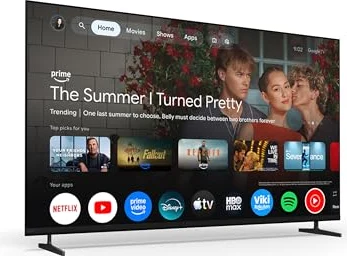
The BRAVIA 3 II fixes the original's biggest gap: it is now a 120Hz TV with four full HDMI 2.1 ports, even at 55 inches. Its picture is still a basic direct-lit LCD, so it suits gamers and bright rooms more than dark-room film watching.
What Changed From the BRAVIA 3
The BRAVIA 3 II (K-55XR30M2) replaces the 2024 Sony 55" BRAVIA 3 (K-55S30). The changes are mostly about speed and connections:
- 120Hz instead of 60Hz. Amazon's spec tables, Notebookcheck and choose.tv agree the panel is native 120Hz at every size; the original was 60Hz. choose.tv called the 120Hz panel "the biggest change".
- Four full HDMI 2.1 ports (48Gbps), all with 4K/120, VRR and ALLM, where the original had no HDMI 2.1 bandwidth. choose.tv's reaction: "4 x HDMI 2.1 48 Gbps, finally!"
- XR Processor in place of the X1. choose.tv and HDTVTest's Vincent Teoh report that it runs on a MediaTek Pentonic 800 chip; Sony has not confirmed this.
- Google TV with Gemini for conversational search and smart home control.
What did not change: there is still no local dimming, and still no HDR10+.
Gaming: The Main Event
Four full-speed HDMI 2.1 ports is unusual at this level, even within Sony's own range, and it means a PS5, an Xbox Series X and a PC can all connect at 4K/120 without swapping cables (eARC for a soundbar is on HDMI 3). VRR runs from 48 to 120Hz, and Sony's Game Menu gathers VRR, motion blur reduction, a black equaliser and a crosshair overlay in one place. PS5 owners also get Auto HDR Tone Mapping and Auto Genre Picture Mode, and Dolby Vision gaming is supported.
Tom's Guide measured input lag at 9.8ms on the 65-inch; choose.tv recorded about 8ms in PC mode. Two limits from choose.tv's testing: there is no 1440p at 120Hz mode, and HGiG tone mapping cannot be switched off, so it suggests setting peak brightness manually to about 450 nits in the console's HDR calibration.
Plug consoles into HDMI 1, 2 or 4 and keep HDMI 3 for an eARC soundbar. On a PS5, let Auto HDR Tone Mapping handle the HDR calibration; on an Xbox, choose.tv's suggestion is a peak of about 450 nits.
Picture: Clear Motion, Limited Contrast
Motion is the standout. choose.tv called it "one of the least smearing LCD TVs" it has tested, and Sony's black frame insertion option worked well in its testing. Colour is solid: Tom's Guide measured an average colour error (Delta E) of about 2.1 in Professional mode and about 95% of the P3 colour space.
Contrast and brightness are the limits. With no local dimming, Tom's Guide listed "not-so-great black levels" among its cons, and dark scenes look greyish in a dark room. Brightness is modest: Tom's Guide measured about 520 nits on a 10% HDR window (65-inch), and choose.tv about 450 nits. Even so, Tom's Guide called it "great for a well-lit room".
Two details are size-specific. First, the 55-inch does not get the anti-glare screen; Sony's listing says that is on the 65- and 75-inch only. Second, the panel type is unresolved: choose.tv reported a VA panel (around 5,000:1 native contrast) on the European model, while RTINGS reportedly found IPS on its 65-inch. VA would favour contrast, IPS viewing angles.
Sound, Smart Features and Setup
Sony's X-Balanced speakers decode Dolby Atmos and DTS:X, but Tom's Guide listed "lacking audio quality" as a con, so plan on a soundbar for films. Google TV with Gemini is clean and quick to search, with Google Cast, AirPlay 2 and PS Remote Play built in; we found no Sony promise on how long the OS will be updated. A physical slider on the TV switches off its built-in microphone, and the remote can be found by pressing the TV's power button.
Check your furniture: the feet sit at the far edges of the TV and cannot be centre-mounted, so you need a stand nearly as wide as the screen. For wall mounting, the 55-inch uses VESA 300 x 300 and weighs about 29 pounds.
Strengths
- ✓Native 120Hz with four full 48Gbps HDMI 2.1 ports (4K/120, VRR, ALLM)
- ✓Very clear motion: choose.tv called it one of the least smearing LCDs it has tested
- ✓Dolby Vision, Dolby Atmos and DTS:X, plus PS5 Auto HDR Tone Mapping
Cons
- ✗No local dimming, so blacks look greyish in a dark room
- ✗Modest brightness (Tom's Guide: about 520 nits HDR on the 65-inch)
- ✗No anti-glare screen at 55 inches (65" and 75" only), and no HDR10+
What Owners Report
Owner discussions on Reddit (r/bravia and r/shubz, May to October 2026) mostly match the reviews. The most detailed 55-inch report, in r/bravia, came from an owner who first called it a stellar TV once the settings were adjusted: Sony's default brightness and sharpening looked artificial to them, and turning processing, brightness and gamma down gave the soft, natural picture they wanted. They also noticed slightly uneven, foggy-grey patches in a dark star field, and later returned the set because it was too large and too bright for their room. A second owner, size not stated, found it too bright for dark-room viewing even at minimum brightness.
The recurring complaint is the dark-room picture: owners of the 65- and 75-inch models describe greyish blacks, uneven dark scenes or light bleed at night, which some tolerate and one owner would not recommend. On the positive side, a 43-inch owner praised console gaming on all four HDMI 2.1 ports, and 65- and 75-inch owners praised daytime brightness and the matte screen, which the 55-inch does not have. Two larger-size owners believe their panels are IPS, which other commenters dispute, so the panel question stays open. These are individual reports, not a defect rate.
What the Reviews Say
Tom's Guide gave the 65-inch four out of five, praising the four HDMI 2.1 ports, the processing and the clean Google TV, and criticising black levels, sound and price. choose.tv scored the European model 7.0 out of 10: strong on motion, HDMI and Dolby Vision, but held back by the lack of local dimming and a price close to Sony's Mini-LED BRAVIA 5. RTINGS's review was not fully readable to us; its summary reportedly calls it a "mediocre TV overall". No outlet has reviewed the 55-inch specifically, so the measurements above come from other sizes.
Alternatives
- TCL 55" QM6K: a Mini-LED with local dimming and 144Hz, for deeper blacks and brighter HDR, on Google TV. See our QM6K review.
- Hisense U6SF Pro: Tom's Guide compared the two after testing both and concluded the Hisense's Mini-LED backlight gives it a significant picture advantage.
- Roku 55" Select (2026): far cheaper and simpler, but 60Hz and much dimmer; Tom's Guide said the BRAVIA 3 II "completely outperforms" it. See our Roku Select review.
Who Should Buy It, and Who Shouldn't
Buy it if you want a 55-inch TV for a PS5 or Xbox at 4K/120, watch a lot of sport or fast action, prefer Sony's processing and Google TV, and watch mostly in a lit room.
Look elsewhere if you watch films in a dark room (a Mini-LED or OLED will have far better blacks), need anti-glare at 55 inches, use HDR10+, or want the most picture for your money.
Frequently Asked Questions
What is the difference between the Sony BRAVIA 3 and BRAVIA 3 II?
The BRAVIA 3 II moves from a 60Hz panel to a native 120Hz panel at every size, including 55 inches, and adds four full-bandwidth (48Gbps) HDMI 2.1 ports with 4K/120, VRR and ALLM. The processor changes from the X1 to the XR Processor, and Google TV now comes with Gemini. It still has no local dimming and no HDR10+.
Is the 55-inch BRAVIA 3 II good for PS5?
Yes, it is one of its strengths. All four HDMI ports support 4K at 120Hz with VRR (48 to 120Hz) and ALLM, and Sony adds PS5-specific Auto HDR Tone Mapping and Auto Genre Picture Mode. Tom's Guide measured input lag at 9.8ms on the 65-inch. One gap: choose.tv found no 1440p at 120Hz mode, which matters to some PC users.
Does the 55-inch BRAVIA 3 II have an anti-glare screen?
No. Sony's Amazon listing says the anti-glare screen is available on the 65- and 75-inch sizes only.
Is the BRAVIA 3 II a VA or IPS panel?
Sources disagree. choose.tv, testing the European version (XR35M2), reported a VA panel with native contrast around 5,000:1, while RTINGS reportedly found an IPS panel on its 65-inch unit. Panel type can differ by size, and Sony does not state it, so treat it as unconfirmed for the 55-inch.
Does it support Dolby Vision and HDR10+?
It supports Dolby Vision, HDR10 and HLG, but not HDR10+. For sound it decodes Dolby Atmos and DTS:X.
Final Verdict
The BRAVIA 3 II fixes the original's biggest gap: it is now a 120Hz TV with four full HDMI 2.1 ports, even at 55 inches. Its picture is still a basic direct-lit LCD, so it suits gamers and bright rooms more than dark-room film watching.
As a 55-inch gaming and sports TV with Sony's motion handling, it makes sense. As a film TV, Mini-LED rivals give you more contrast for similar money.
Sources
This review is based on Sony's product listings, launch coverage, the reviews and lab measurements below, and owner reports. Sony's own spec pages could not be read, and no outlet has tested the 55-inch size. We have not tested the TV ourselves; where a figure comes from a specific reviewer, it says so.
- Tom's Guide, Sony BRAVIA 3 II review, Arif Bacchus (65")
- choose.tv (Wybierz.tv), Sony BRAVIA 3 II review (European XR35M2)
- Notebookcheck, Sony announces prices for six new BRAVIA TVs (2026 launch)
- Tom's Guide, Sony BRAVIA 3 II vs Hisense U6SF Pro
- Amazon listing and spec table, Sony 55" BRAVIA 3 II (K-55XR30M2)
- Amazon listing, Sony 75" BRAVIA 3 II (K-75XR30M2), for the anti-glare size note
- Reddit r/bravia, "Will I regret buying a Bravia 3 II?" owner thread (May 2026)
- Reddit r/shubz, Sony BRAVIA 3 II 65-inch owners thread (October 2026)