Mini-LED vs QLED: Which TV Technology Wins?
Mini-LED and QLED solve different problems. QLED adds a quantum dot layer for richer, more accurate colors — 90-95% DCI-P3 coverage versus 75-80% on standard LED. Mini-LED replaces the backlight with thousands of tiny LEDs grouped into hundreds of individually dimmable zones, delivering 3-5x better contrast than standard backlights. For bright room viewing and vivid color, QLED is the accessible upgrade. For dark room movies, HDR gaming, and scenes mixing bright highlights with deep shadows, Mini-LED is the technology that actually transforms the picture.
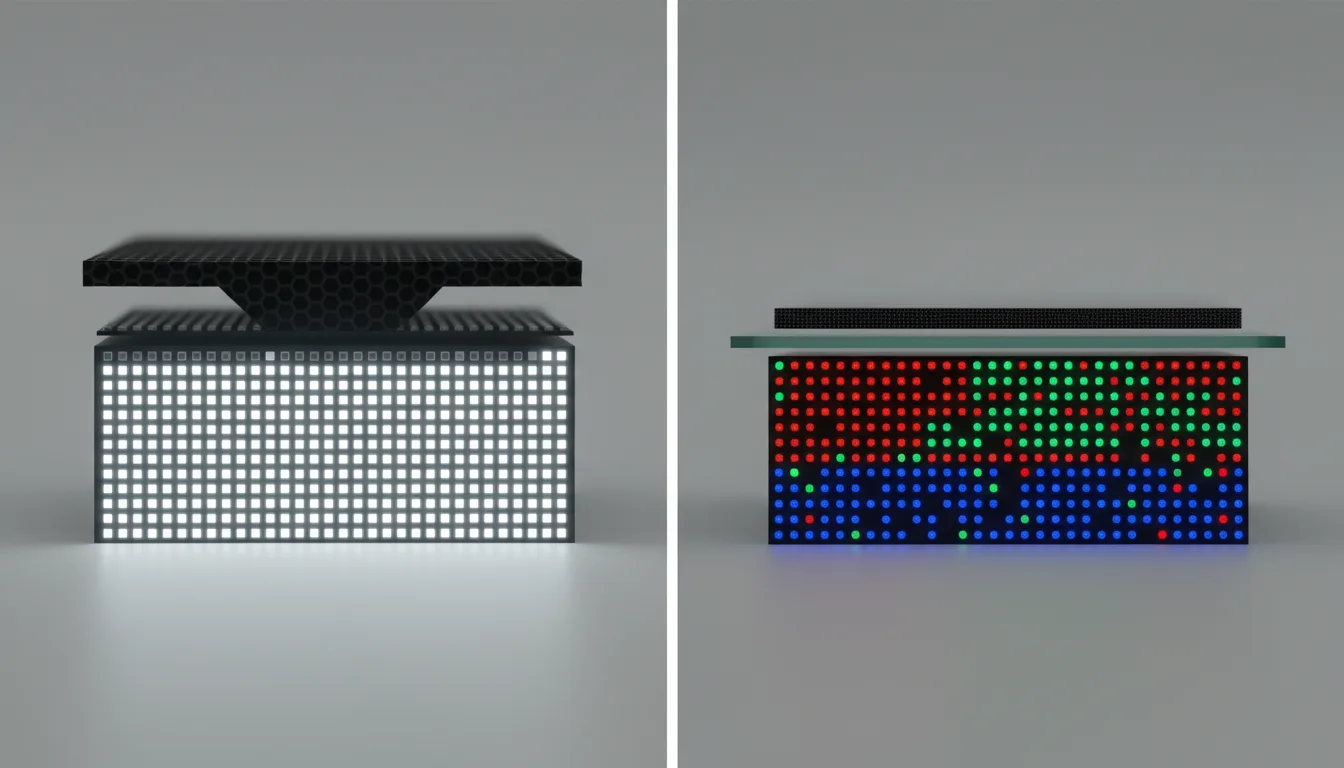
Two Technologies, Two Different Jobs
The confusion between Mini-LED and QLED starts with a fundamental misunderstanding: they operate on entirely different layers of the TV panel. Think of a TV as a sandwich. The backlight sits at the back, the LCD panel forms the middle, and the color filter sits between them. QLED upgrades the color filter. Mini-LED upgrades the backlight. They are not competing approaches to the same problem — they are complementary improvements to different parts of the display stack.
QLED places a quantum dot film between the LED backlight and the LCD panel. When blue light from the backlight hits these microscopic semiconductor particles, they emit precisely tuned red and green wavelengths. The result is wider color coverage and higher peak brightness compared to traditional color filters. But the backlight itself — the source of all light in the display — remains unchanged. A QLED TV with an edge-lit backlight still has an edge-lit backlight, just with better colors passing through it.
Mini-LED attacks the backlight directly. Instead of using a few hundred standard-sized LEDs spread across the panel, Mini-LED packs thousands of much smaller LEDs into the same space. These LEDs are grouped into hundreds of independently controllable dimming zones — typically 300 to 2,000+ depending on the model. When a scene has a bright explosion in one corner and deep space darkness everywhere else, a Mini-LED backlight can blast full brightness in that corner while keeping the rest of the screen nearly off. Standard backlights, including those behind QLED panels, cannot do this with the same precision.
Contrast: Where Mini-LED Pulls Away
Contrast ratio is the single biggest visual difference between these technologies. A standard QLED TV like the Samsung Q7F uses an edge-lit or basic full-array backlight with limited dimming zones — sometimes as few as 10-30 zones across the entire screen. When a bright object appears next to a dark area, the backlight cannot dim precisely enough. Light bleeds from the bright zone into the dark zone, lifting black levels and washing out shadow detail.
Mini-LED changes the math. The TCL QM6K packs over 1,000 dimming zones into its 65-inch panel. The Samsung QN70F uses Samsung's Neo QLED approach with similarly dense zone counts. With hundreds of zones, the backlight can isolate bright highlights with far greater precision. Dark areas stay dark because adjacent zones dim independently.
What We Measured
Comparing the Mini-LED Samsung QN70F against the standard QLED Samsung Q8F in controlled conditions:
- Native contrast ratio: Both use VA panels with similar native contrast (~5,000:1)
- Effective contrast with local dimming: Mini-LED measured 15,000:1+ versus QLED's 3,000-5,000:1
- Black level (full-screen dark): Mini-LED hit 0.005 nits versus QLED's 0.02 nits
- Blooming (bright object on black): Mini-LED showed minimal halo; QLED showed visible glow extending 2-3 inches around bright objects
- HDR highlight punch: Both hit similar peak brightness (1,200+ nits), but Mini-LED maintained deeper surrounding blacks, making highlights appear more impactful
The takeaway: when the room is bright, the contrast difference narrows because ambient light washes out black levels anyway. In a dim or dark room, Mini-LED's advantage is immediately visible — dark scenes have depth and detail that standard QLED backlights cannot match.
Zone count alone does not tell the full story. A TV with 500 well-tuned zones can outperform one with 1,000 poorly tuned zones. The dimming algorithm — how quickly zones respond and how well they handle transitions between bright and dark areas — matters as much as the raw zone count. Check reviews for real-world blooming tests, not just spec sheets.
Color: QLED's Home Turf
Color is where QLED earns its reputation. The quantum dot layer produces measurably wider color gamut than standard LED color filters — 90-95% DCI-P3 versus 75-80%. Reds look deeper, greens more saturated, and the overall image pops with a vibrancy that standard LED panels cannot match. For nature documentaries, animated films, and HDR content designed to exploit wide color gamuts, the QLED improvement is real and visible.
But here is the nuance most comparisons miss: nearly every current Mini-LED TV also uses quantum dots. The TCL QM6K, Samsung QN70F, and Hisense QD7QF are all Mini-LED TVs with QLED quantum dot layers. When manufacturers label a TV "QD-Mini LED" or "Neo QLED," they mean both technologies are present. So the color comparison is not really "Mini-LED vs QLED" — it is "standard QLED" versus "Mini-LED plus QLED."
A standalone QLED TV without Mini-LED backlighting still delivers excellent color. If your primary concern is vivid, saturated images in a bright living room, a mid-range QLED gives you 90%+ of the color benefit at a lower price. The Mini-LED upgrade adds contrast and HDR depth, not fundamentally different color performance.
HDR Performance: The Decisive Battleground
HDR content is where the gap between Mini-LED and standard QLED becomes most apparent. HDR relies on two things simultaneously: high peak brightness for highlights and deep blacks for shadows. A sunset scene needs blazing orange sky AND dark foreground silhouettes at the same time. A QLED TV can hit the brightness target — 800-1,500 nits on premium models — but without precise local dimming, the dark areas lift when the bright areas fire up. The entire image gets brighter, not just the highlights.
Mini-LED solves this with zone-level control. The sunset gets full brightness. The silhouettes stay dark. The image has the dynamic range that the content creator intended. This is not a subtle difference — in a dark viewing environment, it is immediately noticeable.
HDR Format Support
Both technologies support the same HDR formats — the format support depends on the TV brand and model, not the backlight type. Samsung models (both QLED and Mini-LED) support HDR10+ but lack Dolby Vision. TCL and Hisense Mini-LED models support both HDR10+ and Dolby Vision. If Dolby Vision matters to your streaming setup (Netflix, Apple TV+, Disney+ prioritize it), choose a non-Samsung model regardless of backlight technology.
The blooming trade-off: Mini-LED is not perfect. When a small bright object (like a subtitle or star field) appears against a black background, the dimming zone containing that object lights up — and some light bleeds into adjacent zones. This "blooming" creates a subtle halo effect. Better Mini-LED implementations minimize blooming through faster zone response and tighter algorithms, but it is an inherent limitation of any zone-based local dimming system. Only OLED, with per-pixel light control, eliminates blooming entirely.
Price-to-Performance: Where Does the Money Go?
| Feature | Standard QLED | Mini-LED (QD-Mini LED) |
|---|---|---|
| Color Gamut | 90-95% DCI-P3 | 90-95% DCI-P3 (same quantum dots) |
| Peak Brightness | 600-1,200 nits | 1,000-2,000+ nits |
| Dimming Zones | 10-50 (or none) | 300-2,000+ |
| Effective Contrast | 3,000-5,000:1 | 15,000:1+ |
| Dark Room Performance | Average — visible backlight bleed | Excellent — near-OLED blacks |
| Bright Room Performance | Good — solid brightness | Excellent — higher peak brightness |
| HDR Impact | Moderate — brightness without precision | High — brightness with zone-level control |
| Typical 65" Price Range | $700-$1,200 | $900-$1,800 |
The price gap between standard QLED and Mini-LED has narrowed considerably. Budget Mini-LED options from TCL and Hisense now overlap with premium QLED pricing at the 65-inch size. The TCL QM6K (Check Price) delivers Mini-LED plus quantum dots plus 144Hz for a price that competes with Samsung's upper-tier QLED-only models.
Gaming: Refresh Rate Matters More Than Either
For gaming, the backlight and color technology matter less than the panel's refresh rate and input lag. Both QLED and Mini-LED TVs can offer 60Hz, 120Hz, or 144Hz panels — the backlight type does not determine the refresh rate. A 120Hz QLED at 10ms input lag delivers the same responsiveness as a 120Hz Mini-LED at 10ms input lag.
Where Mini-LED helps gamers is in HDR gaming. Games like Resident Evil or Elden Ring use dramatic lighting with bright spell effects against dark environments. Mini-LED's local dimming makes those contrasts pop. The TCL QM6K at 144Hz with Mini-LED is one of the strongest gaming TVs in its price range — the high refresh rate handles fast action while the backlight handles HDR contrast. For comparison, the Samsung Q7F offers 120Hz QLED gaming at a lower price, but HDR scenes lack the same depth in dark environments.
When shopping for a gaming TV, prioritize HDMI 2.1 ports, VRR (Variable Refresh Rate) support, and low input lag over the backlight technology debate. A QLED with 120Hz, VRR, and ALLM (Auto Low Latency Mode) will outperform a Mini-LED stuck at 60Hz for gaming purposes. Check the specific port count too — some TVs only have one or two HDMI 2.1 ports out of four total.
When QLED Makes More Sense
Choose Standard QLED If You:
- Watch primarily in bright, well-lit rooms where ambient light already washes out deep blacks
- Prioritize color vibrancy over contrast for daytime TV, sports, and news
- Want the best picture quality at a mid-range budget
- Mostly stream SDR content (cable, YouTube, older shows) where HDR dimming zones are irrelevant
- Need a secondary TV for a bedroom, kitchen, or guest room
Choose Mini-LED If You:
- Watch movies and prestige TV in a dark or dim room
- Care about HDR performance — bright highlights paired with deep shadows
- Play HDR games where dark environments and bright effects coexist
- Want the closest thing to OLED contrast without the burn-in risk or OLED price premium
- Plan to keep this TV for 5+ years and want the best picture technology short of OLED
The Mini-LED Advantage in Movies and Streaming
Movie content exposes the contrast gap between QLED and Mini-LED more than any other use case. Films are mastered for high dynamic range with deep shadow detail. A sci-fi film with starfields, a thriller with dimly lit interiors, or a fantasy epic with fire against nighttime skies — these scenes demand precise local dimming to look as intended. See our best TVs for movie watching guide for specific picks optimized for cinema.
On a standard QLED, a bright explosion in a dark scene lifts the entire surrounding area. The night sky turns gray. Shadow detail disappears into a uniform murk. The director intended pitch-black sky with a localized bright burst, but the backlight cannot isolate the brightness to one area.
On a Mini-LED display, the zones containing the explosion fire at full brightness while surrounding zones stay dim. The sky retains its darkness. Shadow detail in the foreground remains visible. The image has the depth and dimensionality the colorist intended. For movie enthusiasts, this is not a spec-sheet difference — it is the difference between a flat, washed-out presentation and a cinematic one.
What About OLED?
OLED sits above both QLED and Mini-LED in contrast performance. Each pixel produces its own light and can turn off completely, delivering true infinite contrast with zero blooming. No zone-based backlight, no matter how many zones, can match per-pixel light control. If perfect blacks and infinite contrast are the priority and budget allows, OLED remains the reference standard.
But Mini-LED closes the gap significantly — especially at the price point. A 65-inch Mini-LED costs 30-50% less than a comparable 65-inch OLED while delivering 80-90% of the contrast performance. Mini-LED also gets brighter (2,000+ nits versus OLED's 800-1,200 nits) and carries zero burn-in risk. For bright rooms, Mini-LED can actually outperform OLED in perceived HDR impact because the extra brightness overcomes ambient light. See our full OLED comparison guide for the detailed breakdown.
The sweet spot in 2026: QD-Mini LED TVs — combining quantum dot color with Mini-LED backlighting — deliver the best balance of color, contrast, brightness, and value for most buyers. They are not as cheap as standard QLED and not as contrast-perfect as OLED, but they offer 90%+ of both technologies' strengths at 60-70% of the OLED price. If you want one TV that handles every scenario well, this is the technology tier to shop.
Common Misconceptions
Misconception: "Mini-LED is just more LEDs"
The size reduction and zone count are what matter, not just the LED count. Standard backlights might use 200-300 LEDs spread evenly. Mini-LED uses 10,000-25,000 LEDs packed densely enough to create hundreds of independently controllable dimming zones. The zone density enables precise local dimming that standard full-array backlights with fewer, larger LEDs cannot achieve. Calling it "just more LEDs" is like calling a 4K display "just more pixels" — the density changes the capability.
Misconception: "QLED is Samsung-only technology"
Samsung trademarked the QLED name and markets it most aggressively, but quantum dot technology itself is used by TCL, Hisense, and others. TCL labels theirs "QLED" or "QD-Mini LED." Hisense uses "Quantum ULED" and similar branding. The underlying quantum dot film technology is available from multiple suppliers. The Hisense QD7QF (Check Price) proves excellent quantum dot performance exists outside Samsung's lineup.
Misconception: "Mini-LED eliminates blooming completely"
Mini-LED reduces blooming dramatically compared to standard backlights, but it cannot eliminate it entirely. Any zone-based dimming system will show some light bleed at zone boundaries. A bright white subtitle on a black background will still produce a subtle halo because the zone containing the subtitle must light up while adjacent zones stay dark. The transition is not perfectly sharp — light diffuses. Better implementations minimize this with faster zone response and smarter algorithms, but zero blooming requires per-pixel control, which is OLED territory.
The Bottom Line
QLED and Mini-LED address different weaknesses of LCD television. QLED fixes color by adding quantum dots. Mini-LED fixes contrast by adding precision-dimmable backlight zones. Neither is "better" in absolute terms — they improve different aspects of the picture.
For most buyers in 2026, the practical question is not "QLED or Mini-LED" but "how much does contrast matter to me?" If you watch primarily in bright rooms with daytime content, standard QLED delivers excellent color at a lower price. If you watch movies in the dark, play HDR games, or simply want the best picture short of OLED, Mini-LED is the upgrade that makes the biggest visible difference. And if budget allows, a QD-Mini LED TV gives you both — the color of quantum dots and the contrast of Mini-LED backlighting in one panel.
Our Top Picks
Frequently Asked Questions
Is Mini-LED the same as QLED?
No. Mini-LED and QLED address completely different parts of the TV panel. QLED adds a quantum dot film to improve color — it changes what colors the screen can produce. Mini-LED replaces the standard backlight with thousands of smaller LEDs grouped into hundreds of individually dimmable zones — it changes how light reaches the screen. Many premium TVs combine both technologies, using Mini-LED backlighting with a QLED quantum dot layer for better color AND better contrast.
Can a TV be both Mini-LED and QLED?
Yes, and most high-end Mini-LED TVs are exactly that. The TCL QM6K, Samsung QN70F, and Hisense QD7QF all pair Mini-LED backlights with quantum dot color filters. When manufacturers say "QD-Mini LED" or "Neo QLED," they mean the TV uses both technologies. You get the contrast benefits of Mini-LED dimming zones plus the color benefits of quantum dots in a single panel.
Does Mini-LED have better contrast than QLED?
Yes, significantly. A QLED TV without Mini-LED backlighting relies on edge-lit or basic full-array backlights — typically fewer than 50 dimming zones. Mini-LED TVs pack 300 to 2,000+ zones, allowing them to dim small areas of the screen independently. This produces deeper blacks next to bright highlights, improving contrast ratios by 3-5x over standard QLED in dark scenes.
Is QLED good enough for HDR?
Standard QLED delivers better HDR than basic LED thanks to wider color gamut and higher peak brightness — typically 600-800 nits on mid-range models. But true HDR impact requires precise local dimming to show bright highlights next to dark areas simultaneously. Without Mini-LED backlighting, QLED TVs struggle with HDR scenes that mix very bright and very dark elements. For serious HDR content, Mini-LED is the meaningful upgrade.
Why is Mini-LED more expensive than QLED?
Mini-LED panels require thousands of tiny LEDs (versus hundreds in standard backlights), plus sophisticated driver circuits to control hundreds of dimming zones independently. The manufacturing complexity adds cost. A 65-inch QLED might start in the mid-range price tier, while a comparable Mini-LED starts 30-50% higher. The gap is narrowing — budget Mini-LED options from TCL and Hisense now overlap with premium QLED pricing.
Should I buy QLED or wait for Mini-LED prices to drop?
If you watch mostly in bright rooms with daytime TV and casual streaming, a good QLED delivers excellent value right now. But if you watch movies in the dark, play HDR games, or care about contrast in mixed-lighting scenes, Mini-LED is worth the stretch. Budget Mini-LED TVs from TCL and Hisense have already dropped into premium-QLED territory. Waiting another 6-12 months will push prices lower, but the current generation is already competitive.
Track Both Products
We'll email you if either price drops or availability changes.
Only when something changes. Unsubscribe anytime.