QLED vs LED TVs: What's the Real Difference?
QLED and LED share the same LCD panel and the same LED backlight. The difference is a single layer — quantum dots — that sits in the light path and tunes the colour before it hits the screen. The result is wider colour coverage (roughly 90-95% DCI-P3 versus 75-80%) and 50-80% more peak brightness. For bright rooms and HDR content, that upgrade is immediately visible. For dark-room SDR viewing, standard LED already does most of the job. Everything else that actually matters for picture quality — contrast, black levels, viewing angles, motion — comes from the panel underneath, not the quantum dot layer.
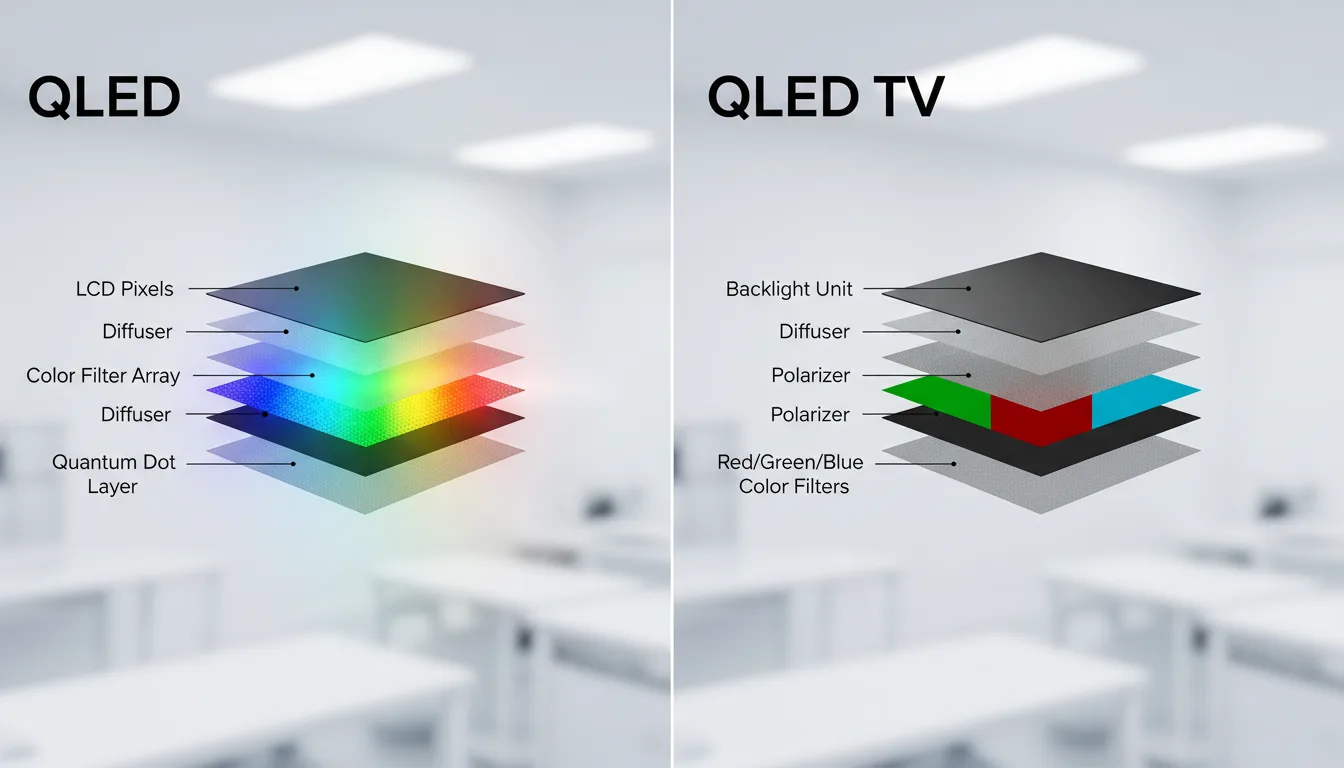
The Technology: One Layer Between Them
When you buy an "LED TV" today, you are getting an LCD panel with LED backlighting. The industry dropped "LCD" from the marketing a decade ago, so every flat-screen TV in the non-OLED aisle is technically an LED-backlit LCD. What manufacturers call "QLED" or "LED" are both LCDs — the panel doing the pixel work is identical.
QLED adds one component to that LCD sandwich: a thin film of quantum dots sandwiched between the blue LED backlight and the LCD panel. Quantum dots are microscopic semiconductor particles tuned to emit very specific wavelengths of red or green light when excited by blue photons. Instead of filtering white backlight through coloured filters (which wastes energy and dulls the hue), the quantum dot layer generates pure, saturated primary colours at the source. More light reaches the screen. The colours that arrive there are cleaner. That is the entire physics story.
Everything else about the TV — the LCD pixels that block or pass light, the backlight array behind the quantum dot layer, the processing chip, the HDMI ports, the operating system — works identically on a QLED and a standard LED panel. This matters because it sets realistic expectations: QLED fixes colour and peak brightness. It does not fix anything else.
Where QLED Actually Pulls Ahead
Colour Volume
This is the biggest measurable gain. Standard LED TVs like the Sony BRAVIA 3 cover around 75-80% of the DCI-P3 cinema colour space — the reference standard for streaming HDR content. QLED sets like the TCL QM6K and Samsung QN70F push that to 93-95%. The gap shows up most clearly on content designed for wide colour gamut — nature documentaries, animated films, Dolby Vision action movies. Skin tones get more subtle gradation, reds and greens look saturated without being cartoonish, and the overall image has more visual depth.
Peak Brightness
Because quantum dots convert light more efficiently than dye-based colour filters, more of the LED backlight's output actually reaches your eye. Standard LED models typically peak in the 400-500 nit range. Mid-range QLED models land in the 600-900 nit zone, and premium QLED with Mini-LED backlighting pushes past 1,200-1,500 nits. That brightness matters in two specific scenarios: rooms with a lot of ambient light (where dim panels get washed out), and HDR highlights (where the peak determines whether a sunset or explosion actually looks luminous).
What Stays the Same
- Contrast ratio — set by the VA or IPS LCD panel type, not the backlight layer
- Black levels — limited by LCD light-blocking ability, not by quantum dots
- Viewing angles — determined entirely by panel type (VA narrows, IPS widens)
- Motion handling — refresh rate and response time come from the panel, not the backlight
- Input lag — a function of the image processor, identical on QLED and LED
- HDMI capability — dependent on the TV model, not the quantum dot layer
A QLED badge does not guarantee premium features. The Samsung Q7F is a QLED that ships without local dimming. Some high-end non-QLED panels include full-array local dimming, 120Hz refresh, and HDMI 2.1 — performance features quantum dots do not provide. Always read the full spec sheet. The QLED label only tells you about colour and brightness; everything else is a separate question.
Side-by-Side Spec Comparison
| Feature | Standard LED | QLED |
|---|---|---|
| Colour Gamut (DCI-P3) | 75-80% | 90-95% |
| Peak Brightness | 400-500 nits | 600-1,500 nits |
| HDR Impact | Modest — brightness limited | Strong — highlights pop |
| Bright-Room Performance | Good if panel is bright enough | Excellent — higher peak output |
| Native Contrast | Depends on panel (VA ~5,000:1) | Depends on panel (same) |
| Burn-In Risk | None | None |
| Expected Lifespan | 60,000-100,000 hours | 60,000-100,000 hours |
| Price Tier | Budget to mid-range | Mid-range to premium |
The headline numbers tell a clear story: QLED upgrades colour and brightness, leaves everything else to the panel, and carries a small price premium that shrinks as screen size grows. On a small bedroom TV the QLED tax can be steep relative to the base price; on a living-room 65- or 75-inch set, the step up is a smaller slice of a bigger cheque.
Does the Colour Difference Actually Matter to You?
This is the question that separates buyers who benefit from QLED from buyers who will not notice. Three things drive whether the colour upgrade pays off.
Your Room Lighting
QLED's peak brightness advantage is wasted in a dim cinema-style room. When the room is dark, a standard 450-nit LED already looks bright. But in a living room with large windows, afternoon sunlight, or multiple lamps, that same 450-nit LED starts looking flat and greyed out. QLED's 800-plus nit output overcomes the ambient light and keeps the image looking punchy. If you are not sure, stand by your couch at the time you usually watch TV and notice the light level. Bright room? QLED earns its keep. Dim room? Save the money.
Your Content Mix
HDR-mastered content — Netflix originals, Dolby Vision streams, 4K Blu-rays, most modern games — is designed to exploit wide colour gamut and high peak brightness. That is QLED territory. Standard SDR content — broadcast cable, older streams, most YouTube — was produced for the narrower Rec. 709 colour space, which any LED TV handles fine. If your evening is mostly new Netflix series and the occasional PS5 game, QLED shows off its advantages. If you are mostly watching live sports feeds and older sitcoms, the upgrade will feel subtle.
Your Screen Size
The bigger the screen, the more the QLED premium makes sense. Colour saturation and brightness look proportionally more impressive at 65 and 75 inches than at 43 inches, partly because larger screens fill more of your visual field. The price math also tilts in QLED's favour at size: the percentage premium shrinks on larger sets. A 75-inch QLED might cost 20-30% more than its LED equivalent, compared to a 40-60% premium on a 43-inch model.
The Mini-LED wrinkle: A growing share of premium LED TVs now use Mini-LED backlighting — hundreds or thousands of small LEDs grouped into independently controllable dimming zones. Mini-LED can match or exceed QLED brightness without quantum dots, and many top Mini-LED sets layer quantum dots on top for both upgrades at once. The TCL QM6K is exactly that combination — Mini-LED backlight plus quantum dot colour in one panel. For buyers considering QLED seriously, it is worth reading our Mini-LED vs QLED breakdown before deciding.
When QLED Is Worth It
- Your main TV lives in a bright, window-lit living room where ambient light currently washes out cheaper LEDs
- You watch HDR content regularly — Dolby Vision or HDR10 streams, 4K Blu-rays, current-gen console games
- You notice and care about colour saturation — nature documentaries, animation, cinematography-driven shows
- You are shopping for a 55-inch or larger screen where the QLED premium shrinks as a percentage of total cost
- You want the colour upgrade but cannot stretch to OLED or Mini-LED pricing
When Standard LED Is the Smarter Buy
- Your viewing is mostly in dim or dark rooms where peak brightness is not the limiting factor
- You mostly stream SDR content — cable, YouTube, older catalogue shows — that does not use wide colour gamut
- You need a secondary TV for a bedroom, kitchen, or guest room where best-in-class picture is not the priority
- You are budget-conscious and would rather spend the QLED premium on a bigger screen size instead
- You are picking up a 43-inch or smaller model where the colour difference is less visually impactful
QLED Myths That Deserve to Die
"QLED is Samsung's answer to OLED"
They compete for the same buyer, but the technologies are unrelated. OLED pixels produce their own light and can turn off completely — each pixel is its own light source. QLED still depends on an LED backlight shining through an LCD panel. That architectural difference drives everything else: OLED gets perfect blacks and infinite contrast but lower peak brightness and some burn-in risk. QLED gets higher peak brightness, no burn-in, and a cheaper price, but cannot hit the same absolute blacks. Neither is universally better. See is OLED worth it? for the full comparison.
"All QLEDs deliver premium picture quality"
The QLED label only guarantees quantum dots. Entry-level QLED models from every brand ship without local dimming, at 60Hz refresh, on edge-lit backlights. A mid-range LED with full-array local dimming and 120Hz can produce a better overall picture than a bargain-bin QLED in the same price range. The quantum dot layer fixes colour and brightness. It does not fix a cheap backlight array or a slow processor.
"QLED is Samsung-only"
Samsung trademarked the QLED acronym and markets it most heavily, but the underlying quantum dot technology is shipped by TCL, Hisense, Vizio, and Sony under different labels. TCL was actually first to market with quantum dot TVs in 2014. The TCL QM6K (Check Price) and Hisense QD7QF (Check Price) both use quantum dot panels at prices competitive with (or cheaper than) Samsung's lineup.
"LED TVs are obsolete"
Far from it. The low-end of the TV market is built around standard LED, and it is not going anywhere. For kitchens, bedrooms, guest rooms, secondary displays, and any scenario where absolute picture quality is not the goal, standard LED delivers a capable image at prices QLED cannot match. The technology is mature, reliable, and cheap. Obsolete would mean no one makes them — every major brand still ships LED TVs in 2026, because they sell.
Room lighting is cheaper to change than a TV. Before spending the QLED premium purely for brightness, try addressing ambient light first. Blackout curtains, repositioning lamps, or viewing during different times of day can make a 450-nit LED feel perfectly bright in the right room. Control the lighting, then decide whether the colour upgrade alone justifies the price difference.
Picking Between Them in 2026
The honest answer: for most living-room primary TVs in 2026, QLED is the more future-proof pick. HDR content keeps growing in availability, streaming services keep pushing wide-colour-gamut mastering, and gaming consoles increasingly assume HDR-capable displays. Standard LED still handles SDR content fine, but the content mix is shifting toward formats where QLED's advantages show up. At the 55-65-inch size class that dominates living-room purchases, QLED's colour and brightness gains justify the price step for most buyers. For secondary sets and smaller screens, standard LED remains the better value.
The next question up the ladder is whether to stretch further to Mini-LED or OLED. See our Mini-LED vs QLED comparison if contrast and HDR punch matter to you, or our OLED breakdown if you are chasing the absolute best picture quality. And our how to choose a TV guide walks through the full decision if you are still narrowing down the shortlist.
Our Top QLED Picks
Frequently Asked Questions
Is QLED better than regular LED?
For colour and brightness, yes — and the gap is measurable, not marketing. QLED panels cover roughly 90-95% of the DCI-P3 colour space versus 75-80% for standard LED, and peak brightness typically runs 50-80% higher. But every other spec that matters — contrast ratio, viewing angles, input lag, motion handling — depends on the underlying LCD panel, not the quantum dot layer. A premium LED TV with full-array local dimming can beat a basic QLED on black levels and HDR impact.
How much more does QLED cost than LED?
Standard LED sits at the budget tier; entry-level QLED typically moves you up one price bracket. The percentage premium shrinks as screen size grows — on a 43-inch model the QLED tax is steep relative to the base price, while on a 75-inch the step up is a smaller slice of a bigger number. Check current pricing on Amazon before committing, since quantum-dot manufacturing costs have dropped substantially year over year.
Do QLED TVs last as long as standard LED?
Effectively identical lifespan. Both use the same LED backlight components rated for 60,000-100,000 hours of use — somewhere between 7 and 11 years at typical viewing hours. Quantum dots are chemically stable and do not degrade faster than the phosphors in standard white LEDs. This is the one area where QLED and LED behave the same, and it is also where both outlast OLED, which can develop burn-in over years of static content.
Can you actually see the difference between QLED and LED?
In a bright room playing HDR content, the difference is obvious within seconds. Reds look deeper, greens more saturated, and peak highlights carry more punch. In a dark room watching standard SDR cable, the difference is subtle — most viewers would not notice without a side-by-side comparison. The QLED upgrade pays off most for daytime viewers, sports fans, and anyone who watches HDR-mastered streaming content regularly.
Is QLED worth it for gaming?
Only if the QLED model has the gaming features you need — the quantum dot layer itself contributes nothing to gaming performance. Input lag, refresh rate, VRR support, and HDMI 2.1 port count all depend on the TV model, not the panel technology. The Samsung Q7F is QLED with 120Hz gaming. The Hisense QD7QF is QLED with 144Hz. Check the gaming spec sheet, not the QLED badge.
Do all Samsung TVs have QLED?
No. Samsung reserves the QLED branding for its Q-series lineup (Q60, Q70, Q80, Q90 and their Neo QLED variants). The cheaper Crystal UHD range uses standard LED with conventional colour filters. Samsung did not invent quantum dot TVs — TCL shipped them first in 2014 — but Samsung trademarked the QLED name and markets it most aggressively. TCL, Hisense, Vizio, and Sony all ship quantum-dot TVs under different labels.
Track Both Products
We'll email you if either price drops or availability changes.
Only when something changes. Unsubscribe anytime.