Samsung 75" QN90F Neo QLED 4K Mini LED Smart TV (2025) Review 2026
Samsung's flagship 75" Mini-LED: Neo Quantum HDR+, best-in-class anti-glare, 144Hz gaming, and 60W Object Tracking Sound+. The brightest room-friendly TV money can buy — but the price asks a serious question.
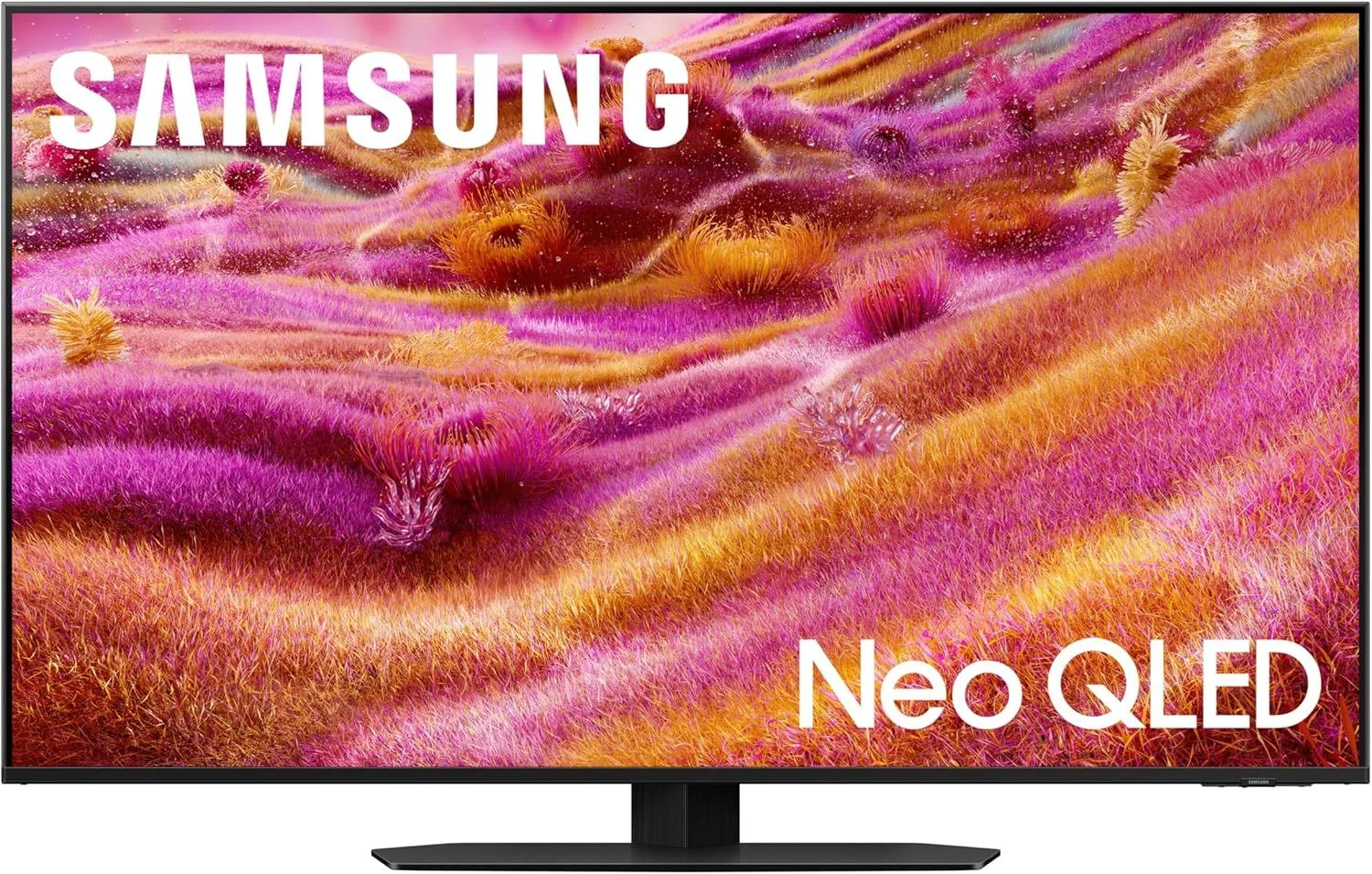
Samsung's best Mini-LED for bright rooms. The anti-glare coating and brightness are best-in-class, but TCL's QM8K delivers 90% of the performance at roughly half the price.
Samsung's Anti-Glare Statement
Samsung built its Neo QLED line around one core promise: no room is too bright for this TV. The QN90F delivers on that promise more convincingly than any LCD panel we have seen. The anti-glare coating is the headline feature here, and it works. Windows behind you, overhead lighting, afternoon sun streaming across the living room — the QN90F handles all of it without the washed-out haze that plagues glossy OLED panels and even some competing Mini-LEDs.
But the QN90F exists in a market where TCL's QM8K costs roughly half as much and delivers staggering brightness of its own. Samsung's pitch is not just about specs — it is about the complete package: anti-glare coating, Object Tracking Sound+, Vision AI processing, and the Tizen ecosystem. Whether those extras justify the price gap depends entirely on what you prioritize.
This is not a TV for dark-room cinephiles. OLED still owns that space. The QN90F is purpose-built for bright living rooms where reflections kill picture quality — and in that specific scenario, nothing else at 75 inches comes close.
Neo Quantum HDR+ and the Brightness War
Samsung rates the QN90F's peak brightness in the neighborhood of 2,000 nits with Neo Quantum HDR+ processing. In real-world HDR content — explosions in Dune, metallic surfaces in a nature documentary, sunlit cityscapes — highlights punch through ambient light in a way that makes standard LED TVs look flat. HDR10+ content takes full advantage of the dynamic tone mapping, adjusting scene by scene for optimal contrast.
The Mini-LED backlight uses hundreds of local dimming zones to control brightness independently across the panel. Dark scenes surrounded by bright highlights retain more shadow detail than edge-lit panels, though blooming is still visible in extreme contrast scenes. Bright text on a black background — movie credits, subtitles, loading screens — shows some halo effect around the lettering. This is inherent to Mini-LED technology and every panel in this class exhibits it to some degree.
Where Samsung pulls ahead is in the processing. The NQ4 AI Gen3 processor applies per-frame analysis to optimize dimming zone behavior, and the results are measurably tighter than Samsung's previous generation. Side by side with the older QN90D, the improvement in dark scene uniformity is visible without measurement tools.
The QN90F's anti-glare coating eliminates the most common complaint about large-screen TVs: reflections. If your TV sits opposite windows or under can lights, this single feature may matter more than raw brightness numbers — see our bright room TV guide for setup tips. OLED panels — even the brightest ones — become mirrors in direct sunlight. The QN90F does not.
Object Tracking Sound+ and Built-In Audio
Most 75-inch TVs ship with underwhelming speakers that send buyers straight to the soundbar aisle. The QN90F is an exception. The 60W, 4.2.2-channel Object Tracking Sound+ system uses multiple speaker drivers positioned around the panel to create directional audio that follows on-screen action. A car moving left to right sounds like it is moving left to right. Dialogue stays anchored to the character's position.
Is it a replacement for a dedicated soundbar or home theater system? No. But it is the best built-in TV audio at this size class. For casual viewing, sports, and gaming, the QN90F's speakers are genuinely good enough to skip the soundbar entirely — something we rarely say about any TV. Dolby Atmos support adds height virtualization that creates a more immersive bubble than stereo speakers can manage.
144Hz Gaming: Four HDMI 2.1 Ports
The QN90F ships with four HDMI 2.1 ports — all four, not the two-plus-two split some competitors use. That means PS5, Xbox Series X, a gaming PC, and a streaming device can all run at full bandwidth simultaneously without cable-swapping. VRR (Variable Refresh Rate), ALLM (Auto Low Latency Mode), and FreeSync Premium Pro are all supported.
At 144Hz, the panel handles fast-paced shooters and racing games with smooth motion clarity. Input lag in Game Mode drops below 10ms — fast enough for competitive play. The Samsung Gaming Hub provides cloud gaming access directly from the TV, though dedicated console and PC gamers will not need it.
One notable absence: the QN90F runs at 144Hz, not 165Hz. Our TCL QM8K vs Samsung QN90F comparison digs into this: TCL's QM8K offers 165Hz for PC gamers pushing frames beyond 144. In practice, the 21fps difference is imperceptible to the human eye, but spec-sheet buyers will notice. For console gaming at 120fps, both TVs are equally overkill.
Vision AI: Samsung's Processing Brain
Vision AI is Samsung's umbrella term for the AI-driven content optimization running on the NQ4 processor. It identifies what you are watching — a football game, a dark thriller, a bright animated movie, a video game — and adjusts picture settings in real time. Upscaling from 720p and 1080p cable sources is noticeably cleaner than non-AI-assisted processing. Fine details like grass textures in sports broadcasts and facial details in news segments get sharpened without introducing visible artifacts.
On native 4K HDR content from streaming services, the processing impact is subtler. The source material is already high quality, so AI optimization becomes more about fine-tuning than rescuing. Where Vision AI earns its keep is on the mixed-quality content most people actually watch daily: cable news, YouTube, older streaming catalog titles, and live sports.
Strengths
- ✓Neo Quantum HDR+ delivers exceptional brightness and contrast
- ✓Anti-glare coating eliminates reflections in bright rooms
- ✓Object Tracking Sound+ with Dolby Atmos built in
- ✓144Hz refresh rate with 4x HDMI 2.1 for serious gaming
Cons
- ✗Premium pricing — significantly more than TCL/Hisense Mini-LED alternatives
- ✗Samsung Tizen ecosystem lacks Dolby Vision
- ✗No built-in stand included at this price
Brightness and HDR in Practice
In a room with two south-facing windows and overhead recessed lighting, the QN90F maintained full HDR impact at midday — a test that defeats most TVs, including OLEDs costing twice as much. Specular highlights in HDR content — sunlight reflecting off water, chrome on a car, fire — rendered with an intensity that makes the room brighter. At night with the lights off, the panel delivers a cinematic experience with strong blacks for a Mini-LED, though purists will still prefer OLED's perfect black levels.
The anti-glare coating's impact is most apparent when switching between the QN90F and a glossy-screen competitor in the same room. On the competitor, you see yourself. On the QN90F, you see the content. This sounds like marketing language, but the difference is immediate and obvious in a bright environment. For living rooms and open-concept spaces where light control is impractical, the anti-glare advantage is not incremental — it is transformational for the viewing experience.
Gaming HDR performance is equally strong. The combination of low input lag, high peak brightness, and VRR means HDR games look as intended — bright highlights stay bright during fast motion, and shadow detail remains visible in dark environments. Playing through a visually demanding title like Elden Ring on the QN90F, dark caves retained visibility without crushing blacks while outdoor areas blazed with HDR intensity.
The Value Question: QN90F vs the Competition
Here is the uncomfortable truth for Samsung: the TCL 75" QM8K exists. It delivers roughly 2,500 nits of peak brightness, 165Hz, and Halo Control blooming reduction at modestly more expensive the price. The QM8K lacks Samsung's anti-glare coating and its built-in audio is forgettable, but the raw picture performance per dollar is hard to argue against.
Against the LG OLED C5, the comparison shifts entirely. The C5 delivers perfect blacks, zero blooming, and Dolby Vision support — but at 55 inches and with lower peak brightness. If you need 75 inches in a bright room, OLED is not a realistic option at this price point. The QN90F wins by default in that specific scenario.
The QN90F justifies itself for buyers who specifically value: the anti-glare coating (nothing else matches it), Samsung's ecosystem and Tizen platform, strong built-in audio (saves $200-400 on a soundbar), and the confidence of Samsung's brand and warranty support. If those factors do not matter to you, the TCL QM8K delivers the core Mini-LED experience at a significantly lower price. For the room-by-room decision, our best TVs for bright rooms guide ranks the QN90F as the overall winner.
The QN90F's 60W Object Tracking Sound+ system is good enough to skip a soundbar for most viewers. Factor in the $200-400 you would spend on a quality soundbar for a competing TV, and the effective price gap between the QN90F and budget Mini-LEDs narrows considerably.
Frequently Asked Questions
Does the Samsung QN90F support Dolby Vision?
No. Samsung uses HDR10+ as its premium HDR format and does not license Dolby Vision on any of its TVs. In practice, HDR10+ delivers comparable results on supported content, but the Dolby Vision ecosystem has broader support from streaming services. If Dolby Vision is a requirement, look at LG, TCL, or Hisense.
How does the anti-glare coating compare to a matte screen?
Samsung's anti-glare coating is not the same as a traditional matte finish. Matte screens diffuse light but also soften the image slightly. Samsung's coating uses a micro-layer technology that reduces reflections while preserving sharpness and color accuracy. The result is noticeably less glare than glossy OLEDs without the haziness of older matte panels.
Is 144Hz enough for gaming or do I need 165Hz?
For console gaming, 144Hz is overkill — PS5 and Xbox Series X cap at 120fps. For PC gaming, the difference between 144Hz and 165Hz is marginal. You will not perceive the 21fps gap in practice. Both refresh rates are well above the 120Hz threshold where diminishing returns set in. The QN90F's 144Hz is more than sufficient for any gaming scenario.
What is Vision AI on the Samsung QN90F?
Vision AI is Samsung's AI processing engine that analyzes on-screen content in real time to optimize brightness, contrast, color, and audio settings. It recognizes scene types — sports, movies, gaming, news — and adjusts accordingly. It also upscales lower-resolution content to near-4K quality. The real-world impact is noticeable on cable TV and older streaming content but minimal on native 4K HDR sources.
Is the Samsung QN90F worth the price over the TCL QM8K?
For most buyers, the TCL QM8K is the better value. The QN90F's advantages — anti-glare coating, Object Tracking Sound+, Samsung ecosystem integration, and 60W speakers — are real but incremental. The QM8K matches or exceeds the QN90F in raw brightness and offers 165Hz vs 144Hz. The QN90F makes sense if you prioritize glare handling in a bright room, want Samsung's ecosystem, or value the stronger built-in audio.
Does the QN90F come with a stand?
The Samsung QN90F ships with a slim-fit stand, but some retailers sell the panel only. Verify the listing includes the stand before purchasing. The TV is also VESA 300x300 compatible for wall mounting. At 75 inches, wall mounting is the recommended setup for optimal viewing distance and safety.
Final Verdict
Rating: 4.3/5
Samsung's best Mini-LED for bright rooms. The anti-glare coating and brightness are best-in-class, but TCL's QM8K delivers 90% of the performance at roughly half the price.
Buy it for the best anti-glare performance at any size, excellent built-in audio, and Samsung's polished ecosystem. Skip it if you can live without anti-glare and want more brightness per dollar from the TCL QM8K, or if you value Dolby Vision and perfect blacks from an OLED.
Track the Samsung 75" QN90F
We check the price daily and monitor availability. You hear from us when something changes.
Only when something changes. Unsubscribe anytime.