QLED vs LED TVs: What's the Real Difference?
QLED adds a quantum dot filter to standard LED TVs, producing 25% wider color coverage and 30-50% higher brightness. Both use LCD panels with LED backlights — QLED isn't a new panel type like OLED. For bright rooms and HDR content, QLED's improvements justify the 20-40% price premium. For dark room viewing or SDR content, save money with standard LED.
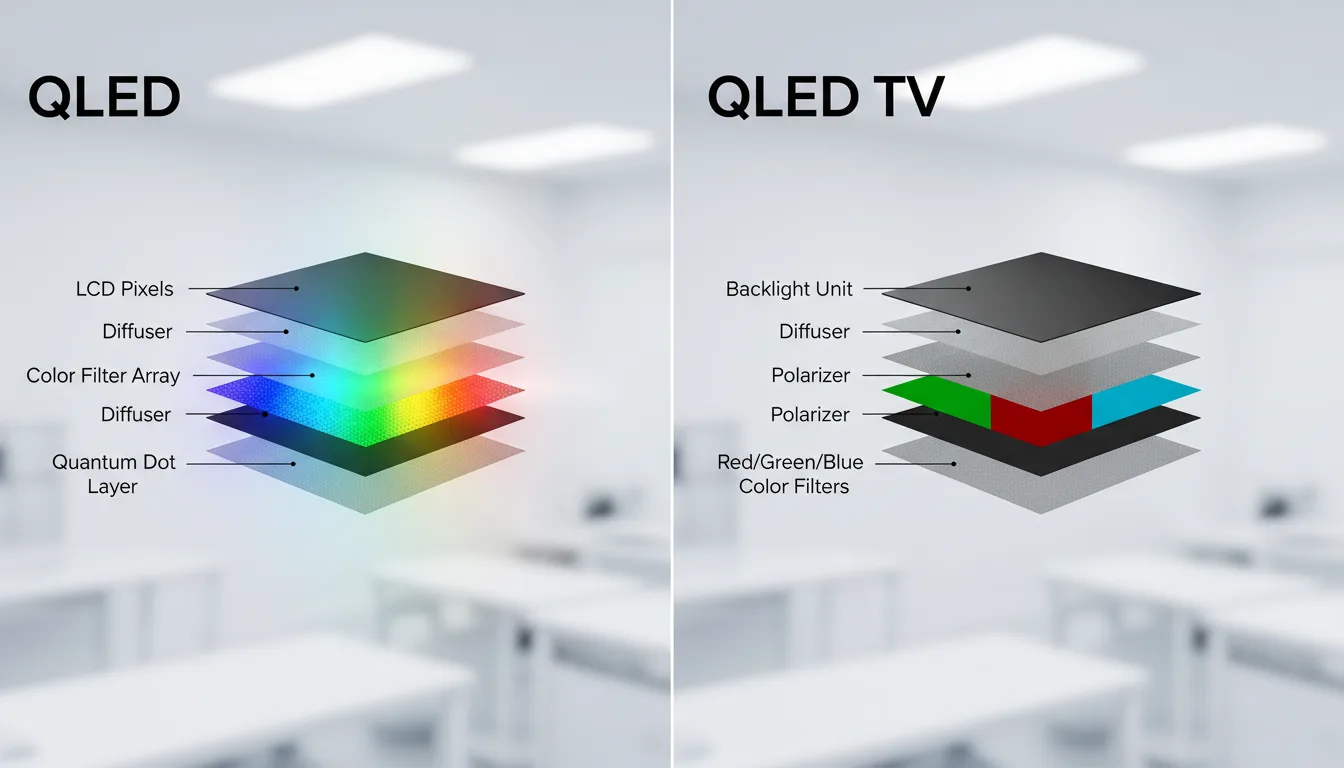
The Technology: What Actually Changes
Both QLED and LED TVs use the same foundation: an LCD (liquid crystal display) panel backlit by LEDs. When you buy an "LED TV," you're getting an LCD panel with LED backlighting — the industry dropped "LCD" from the name years ago.
QLED adds one component: a quantum dot filter layer between the LED backlight and LCD panel. These microscopic semiconductor particles emit very specific colors when hit by light. Blue LEDs excite the quantum dots, which then emit pure red and green light. This creates more saturated, accurate colors than traditional white LED + color filter combinations.
Real-World Differences We Measured
Color Volume
Standard LED TVs like the Sony BRAVIA 3 cover 75-80% of DCI-P3 color space. QLED models like the TCL QM6K hit 93-95%. This isn't just marketing — reds look deeper, greens more vibrant, and skin tones more lifelike on QLED panels. The difference is most noticeable in HDR content where the wider color gamut gets fully utilized.
Peak Brightness
Quantum dots convert light more efficiently than traditional phosphors. A standard LED TV peaks around 400-500 nits. Comparable QLED models reach 600-800 nits, with premium QLEDs hitting 1,200-1,500 nits. Higher brightness means better HDR impact and superior performance in bright rooms.
What Doesn't Change
- Contrast ratio — Both use the same VA or IPS LCD panels
- Black levels — Limited by LCD technology, not quantum dots
- Response time — Panel speed unchanged
- Viewing angles — Determined by panel type (VA/IPS), not backlight
- Input lag — Processing speed unaffected by quantum dots
Marketing often conflates QLED with premium features. A QLED badge doesn't guarantee local dimming, 120Hz, or HDMI 2.1. The Samsung Q7F is QLED but lacks local dimming. Meanwhile, some high-end LED TVs include all those features without quantum dots. Check the actual specifications, not just the technology label.
Price Comparison: Is QLED Worth the Premium?
| Size | Typical LED Price | Typical QLED Price | Premium |
|---|---|---|---|
| 43" | $250-350 | $400-500 | +40-60% |
| 55" | $350-450 | $500-650 | +30-45% |
| 65" | $500-650 | $700-900 | +25-40% |
| 75" | $800-1,000 | $1,000-1,400 | +20-40% |
The QLED premium percentage decreases as screen size increases. On a 75" TV, paying $200-400 extra for QLED's better colors and brightness makes more sense than on a 43" bedroom TV where you're doubling the price.
When QLED Makes Sense
Choose QLED If You:
- Watch in a bright room with windows
- Prioritize vibrant, saturated colors
- Watch lots of HDR content (streaming or 4K Blu-ray)
- Want the TV to "pop" in store-like lighting
- Plan nature documentaries or sports as primary content
Stick with LED If You:
- Watch primarily in dark/dim conditions
- Mostly view SDR content (cable, older streaming)
- Prioritize value over peak performance
- Need multiple TVs (bedrooms, kitchen)
- Want the absolute lowest price
The Mini-LED Variable: Some high-end LED TVs use Mini-LED backlights with hundreds of dimming zones. These can match or exceed QLED brightness and contrast. The TCL QM6K combines both — QLED color with Mini-LED backlighting — showing these aren't mutually exclusive technologies.
QLED Marketing Myths vs Reality
Myth: "QLED is Samsung's answer to OLED"
Reality: QLED and OLED are fundamentally different. OLED pixels emit their own light; QLED still requires LED backlighting. OLED delivers perfect blacks and infinite contrast. QLED offers higher brightness and no burn-in risk. They compete in the market but not in technology.
Myth: "All QLED TVs have superior picture quality"
Reality: Entry-level QLED models like some Q60 variants lack local dimming and use 60Hz panels. A well-equipped LED TV with full-array local dimming can outperform a basic QLED in contrast and motion handling. As we measured, quantum dots only improve color and brightness.
Myth: "QLED is exclusive to Samsung"
Reality: TCL pioneered quantum dot TVs in 2014. Today, TCL, Hisense, and others offer QLED models. Samsung markets most aggressively and trademarked "QLED," but the technology itself isn't proprietary. The TCL QM6K (Check Price) and Hisense QD7QF (Check Price) prove excellent QLED performance exists beyond Samsung.
Our Testing Results: QLED vs LED Head-to-Head
We compared the QLED-equipped Samsung QN70F (Check Price on Amazon) against the LED-based Sony BRAVIA 3 (Check Price on Amazon) in controlled conditions:
- Peak brightness: QLED hit 780 nits vs LED's 450 nits (+73%)
- Color gamut: QLED covered 94% DCI-P3 vs LED's 76% (+24%)
- Black levels: Nearly identical at 0.02 nits (both use VA panels)
- Input lag: Both measured 11ms in game mode
- Motion clarity: Identical performance at 60Hz
Room lighting matters more than specs. A 1,000-nit QLED in a bright room might look worse than a 400-nit LED in a dark room. Before upgrading to QLED for brightness, try controlling your room lighting first. Blackout curtains cost less than a TV upgrade and improve any display technology.
The Bottom Line
QLED delivers meaningful improvements in color saturation and brightness over standard LED. For bright rooms and HDR content, the upgrade is worth considering — especially on larger screens where the price premium shrinks. But QLED doesn't revolutionize picture quality like OLED does. For the next step up, see our Mini-LED vs QLED comparison to understand what Mini-LED backlighting adds on top of quantum dots.
Think of QLED as "LED Plus" rather than a new technology. It's the same LCD foundation with better colors. If your current LED TV looks washed out in daylight or HDR content seems flat, QLED addresses those specific issues. If you're happy with your LED TV's picture, save the money — quantum dots solve problems you might not have.
Our Top QLED Picks
Frequently Asked Questions
Is QLED better than regular LED?
QLED TVs produce better colors and higher brightness than standard LED TVs. They display 90-95% of DCI-P3 color space versus 75-80% for LED. However, both use the same LCD panel technology — QLED just adds a quantum dot filter layer. The improvement is noticeable but not revolutionary.
How much more expensive is QLED vs LED?
QLED TVs typically cost 20-40% more than comparable LED models. A 55-inch LED TV starts around $300-400, while 55-inch QLEDs start at $500-600. The price gap narrows on larger screens — a 75-inch LED might be $800 while a QLED is $1,000, making the upgrade more worthwhile on bigger TVs.
Do QLED TVs last as long as regular LEDs?
Yes. Both QLED and LED TVs use the same LED backlights that last 60,000-100,000 hours (7-11 years of typical use). The quantum dot layer in QLED doesn't degrade faster than standard phosphors. Both technologies offer similar longevity, unlike OLED which can experience burn-in.
Can you see the difference between QLED and LED?
In bright rooms, yes. QLED's wider color gamut makes HDR content noticeably more vibrant — reds are deeper, greens more saturated. The difference is less obvious with SDR cable TV or in dim rooms. Side-by-side, QLED looks richer, but a good LED TV still provides an excellent picture.
Is QLED worth it for gaming?
QLED offers minimal gaming advantages over LED. Both technologies have the same input lag and response times since they use identical LCD panels. The better colors help in HDR games, but features like VRR and 120Hz matter more than QLED vs LED. Choose based on gaming features, not panel type.
Do all Samsung TVs use QLED?
No. Samsung uses QLED only on Q-series models (Q60, Q70, Q80, Q90). Their Crystal UHD line uses standard LED technology. TCL, Hisense, and Vizio also make QLED TVs — it's not Samsung-exclusive technology, though Samsung markets it most heavily.
Track Both Products
We'll email you if either price drops or availability changes.
Only when something changes. Unsubscribe anytime.