TV Budget Guide: What You Get at Every Price
TV pricing follows a curve, not a line. The jump from a budget LED to a Mini-LED delivers a massive picture quality improvement. The jump from Mini-LED to OLED is smaller. And the jump from a base OLED to a flagship OLED is the smallest of all. Knowing where the diminishing returns kick in saves you hundreds without sacrificing the features that actually matter to your eyes.
The Price Brackets Explained
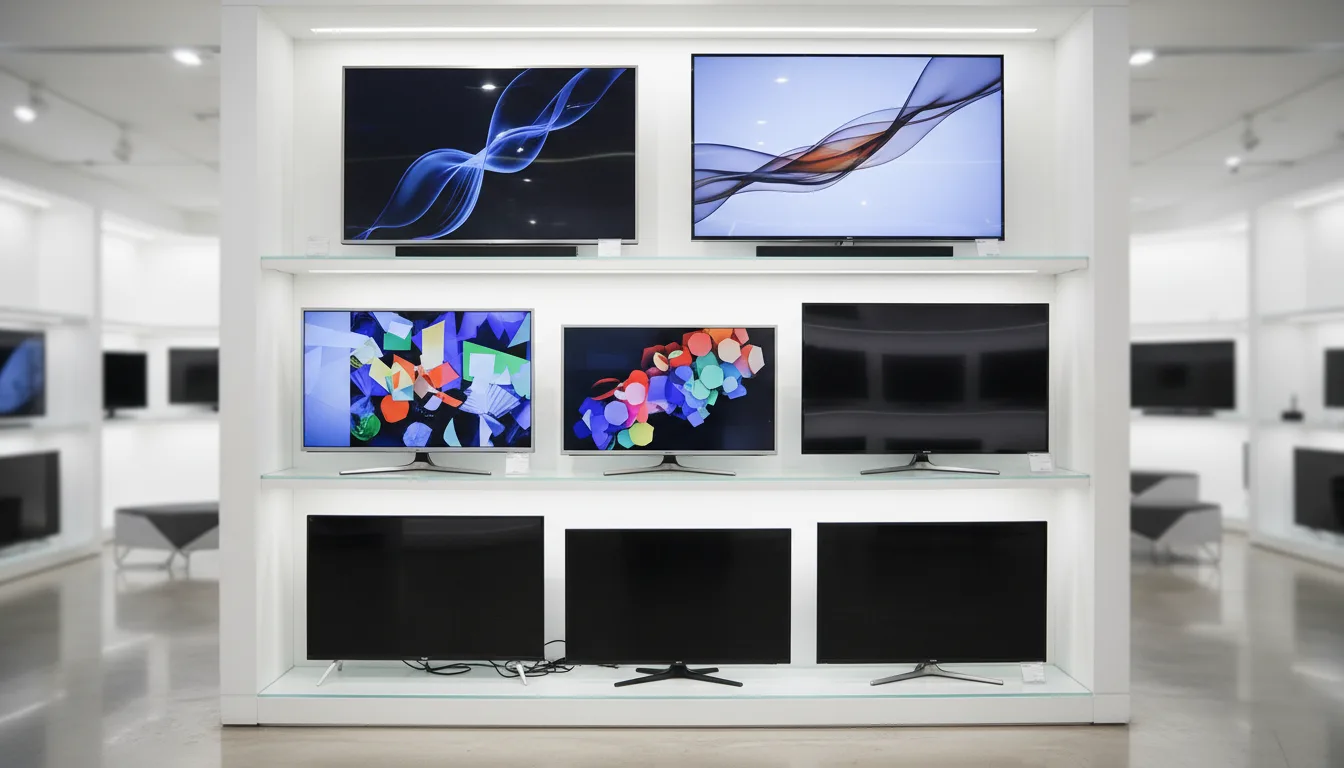
Every TV on the market falls into one of five price tiers. Each tier has a specific set of capabilities and compromises. Understanding what you gain — and what you give up — at each level is the single most important piece of TV buying knowledge.
Under $300: The Basics
This is the entry point. You get a 4K panel with a functional smart platform — Fire TV, Roku, or Google TV. The picture is adequate for streaming in rooms where you sit within 8 feet and directly in front. Colors are decent. Brightness is limited. Viewing angles are narrow.
What You Get
- 55-inch 4K resolution with basic HDR (HDR10, sometimes Dolby Vision)
- A working smart TV platform with all major streaming apps
- Adequate picture for casual streaming, news, and daytime TV
- Brand-name sets from Insignia, Toshiba, Roku, and Amazon
What You Miss
- Local dimming — blacks look gray in dark scenes
- 120Hz refresh rate — everything is 60Hz at this tier
- Serious HDR performance — the brightness simply is not there
- Good built-in speakers — budget for a soundbar
The Insignia 55" Fire TV at Under $300 is the floor price for a recognized-brand 55-inch 4K TV. It does the job for dorm rooms, guest rooms, and secondary screens. Read our review.
Under $300 TVs are best as secondary screens — a bedroom TV, a kitchen TV, a garage TV. For your main living room where you watch movies and play games, stepping up to the next tier buys dramatically more picture quality per dollar.
$300 to $500: The Sweet Spot for Casual Viewers
This bracket opens up 65-inch screens, QLED color enhancement, and on some models, 120Hz panels. The picture quality gap between this tier and budget is visible to anyone — richer colors, better contrast, and smoother motion. For households where the TV is primarily a streaming device, this tier covers everything you need.
What You Gain Over Budget
- 65-inch screens from reputable brands (and 75-inch budget options)
- QLED or enhanced color processing on many models
- 120Hz panels on select Samsung and Roku models — smoother sports and gaming
- Better built-in speakers (though still not great)
- Some models with basic local dimming
The Roku 65" Pro Series at $300–$500 sits in this bracket and delivers QLED color, 120Hz, and local dimming — features you would not find at any price two years ago. Read our review.
This is also where Mini-LED enters the picture. Entry-level Mini-LED TVs from Hisense and TCL start under $500 at 55 inches. They sacrifice gaming features (60Hz panels) but deliver noticeably better contrast than any QLED at this price. If you do not game, a 55-inch Mini-LED at $350 is a remarkable value proposition.
$500 to $800: The Performance Tier
This is where TVs start looking genuinely impressive. Mini-LED backlighting with hundreds of dimming zones. 144Hz panels for gaming. Peak brightness above 1,500 nits for impactful HDR. At this tier, you are buying a TV that makes you stop and notice the picture quality.
What Changes
- Mini-LED backlighting with 400-800 dimming zones — dark scenes gain real depth
- 144Hz refresh rates with VRR for serious gaming
- Peak brightness above 1,500 nits — HDR highlights actually pop
- 65-inch Mini-LED or 75-inch Mini-LED entry options
- Dual HDMI 2.1 ports for multi-console gaming setups
The TCL 65" QM6K at $500–$800 delivers Mini-LED and 144Hz at a price that undercuts most 65-inch QLEDs. It is the value champion of this tier. Read our review.
$800 to $1,200: Premium Without Compromise
This tier offers two paths: high-end Mini-LED with 800-1,000+ dimming zones, or entry-level OLED. Both deliver reference-level picture quality that satisfies enthusiasts. The choice between them depends on your room — bright rooms favor Mini-LED's brightness, dark rooms favor OLED's perfect blacks.
Mini-LED at This Tier
- 800-1,000+ dimming zones for near-OLED contrast performance
- Peak brightness approaching 2,000 nits — HDR content looks stunning
- 144Hz gaming with full VRR support
- Samsung anti-reflection coatings for bright rooms
The Hisense 65" U75QG at $500–$800 packs flagship-adjacent specs — high zone count, 144Hz, and 1,800 nits — into this bracket. Read our review.
OLED at This Tier
The LG 55" OLED C4 at $800–$1,200 represents last year's OLED at a steep discount. You get self-emissive pixels with perfect blacks, infinite contrast, and sub-1ms gaming response time. It is 90% of the current-gen C5 for less money. Read our review.
Above this tier, you pay increasingly more for increasingly smaller improvements. A premium Mini-LED at this price delivers 90% of what a flagship does. An entry OLED delivers an experience that most viewers cannot distinguish from models twice the price. For most buyers, this tier is the ceiling of worthwhile spending.
Above $1,200: Flagship Territory
Current-generation OLEDs, Tandem OLED technology, flagship Mini-LEDs with 2,500+ nits, and premium 75-inch panels. These TVs are for enthusiasts who notice and care about the last 5-10% of picture quality. The improvements are real but subtle — better processing, higher peak brightness, wider color gamuts, and more refined motion handling.
When Flagship Spending Makes Sense
- You watch in a dedicated home theater or dimly lit room where differences are visible
- You are a cinephile who cares about color accuracy and reference-level calibration
- You want the absolute best gaming experience (Tandem OLED brightness + OLED response time)
- You wall-mount in a living room and want the TV to be a design statement
When It Does Not
- The TV sits in a bright family room — a mid-range Mini-LED handles glare better
- You mostly watch cable news and daytime TV — the content does not benefit from premium panels
- Multiple family members use the TV — the premium features go unnoticed by most viewers
The Budget Allocation Hierarchy
If you have a fixed TV budget, allocate it in this order for maximum impact:
- Panel technology first — Mini-LED over QLED, OLED over Mini-LED. A smaller Mini-LED looks better than a larger QLED.
- Screen size second — Within your chosen technology, get the largest size your room supports. Use our TV size guide to calculate the ideal size for your viewing distance.
- Refresh rate third — 120Hz matters for gamers and sports fans. If you only stream shows and movies, 60Hz is acceptable.
- Brand and platform last — Do not pay a brand premium when a competitor offers the same specs for less. See our platform comparison to pick the interface you prefer.
Common Budget Mistakes
1. Buying the Biggest Screen Regardless of Technology
A 75-inch budget LED looks worse than a 65-inch Mini-LED from the same viewing distance. Bigger is not always better. Match screen size to viewing distance, then maximize panel quality within your budget.
2. Paying for Features You Will Not Use
If you do not game, a 120Hz panel adds nothing. If you do not have smart home devices, Fire TV's Alexa integration is irrelevant. If you do not own Samsung products, the Tizen ecosystem premium is wasted. Buy the features you actually need.
3. Ignoring the Soundbar Budget
Every TV under $1,000 has mediocre built-in speakers. Budget $100-$200 for a soundbar alongside the TV purchase. A $500 TV with a $150 soundbar will deliver a better total experience than a $650 TV with built-in speakers.
4. Shopping Off-Brand to Save $50
Unknown TV brands save you a small amount upfront but cost you in software support, warranty service, and app updates. Stick with recognized brands — the modest premium pays for years of reliable software updates.
The timing hack: TV prices drop 20-40% during sales events. A premium Mini-LED on Black Friday costs less than a mid-range QLED at full price. Check our best time to buy guide to time your purchase for maximum savings.
Frequently Asked Questions
What is the cheapest 4K TV worth buying?
Is it worth spending more on a TV?
What size TV can I get for $500?
Should I buy a refurbished TV to save money?
Do I need OLED or can I save with Mini-LED?
What features should I skip to save money?
Start With Your Budget, End With the Right TV
Every dollar matters differently at each price tier. Under $300 buys a functional screen. $300-$500 buys a good TV. $500-$800 buys a TV that impresses you. Above $800, you are paying for refinement that only enthusiasts notice. Our top budget pick is the TCL 65" QM6K for outstanding picture quality at the performance tier, and the Insignia 55" Fire TV for buyers on the tightest budget. Browse our full budget TV roundup for every option ranked.
Ready to Buy? Start Here
Based on this guide, our #1 recommendation:
Toshiba 65" C350 Series Best budget value — Dolby Vision and solid picture quality at an entry-level price Read Full Review →Can't Decide? Compare Side by Side
Get Our Top 3 Picks
Get our top 3 picks for your budget — one email, then only updates.
Only when something changes. Unsubscribe anytime.