TCL 65" QM7K QD-Mini LED 144Hz Smart TV Review 2026
A thousand dimming zones, 2000 nits, 144Hz gaming, and AIPQ PRO processing. The QM7K delivers what used to cost twice as much from Samsung and Sony. This is the Mini-LED sweet spot.
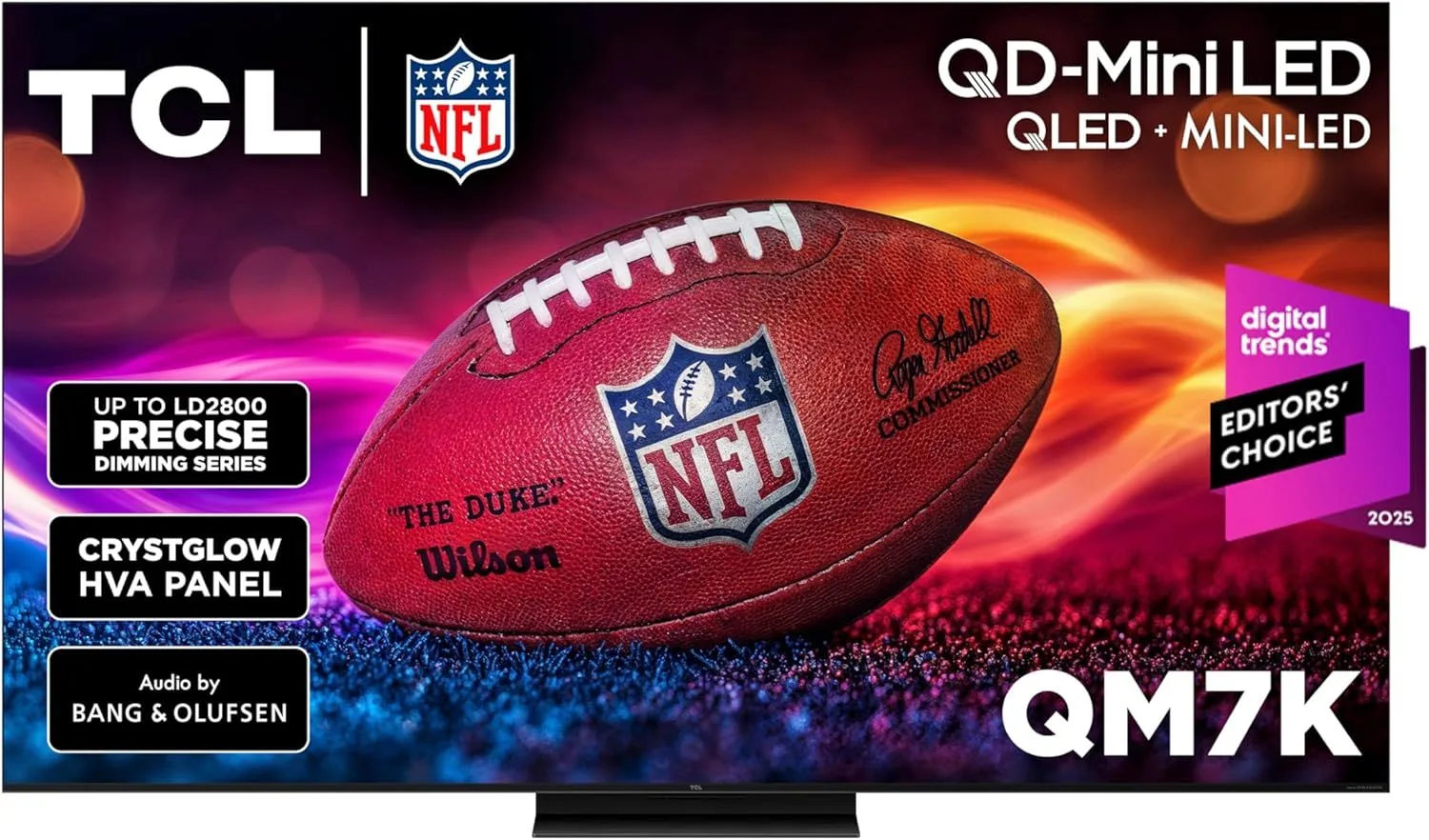
TCL's QM7K delivers near-reference brightness and zone count at hundreds less than Samsung and Sony equivalents. The sweet spot for buyers who want flagship picture quality without flagship pricing.
Flagship Performance, Mid-Range Price
The QM7K exists to embarrass more expensive TVs. Around 1000 dimming zones at 65 inches means the backlight can isolate bright objects from dark backgrounds with precision that entry Mini-LEDs cannot match. A bright explosion in a dark cave. A streetlamp against a night sky. A lit window in a dark building facade. These mixed-brightness scenes are where zone count matters most, and the QM7K handles them with confidence.
Peak brightness around 2000 nits drives HDR content with authority. Specular highlights — the glint of sunlight on water, a welding spark, lightning in a storm — carry physical intensity. Watching HDR content on the QM7K after using a standard QLED feels like taking off sunglasses. The dynamic range is that much wider.
What AIPQ PRO Actually Does
TCL's AIPQ PRO processor is the QM7K's secret weapon. It analyzes content scene by scene and adjusts HDR tone mapping, color saturation, and local dimming behavior dynamically. The result: shadow details are preserved in dark scenes that lesser processors crush to pure black. Skin tones maintain accuracy across lighting conditions. Color gradients in sunsets and sky scenes show smoother transitions.
Compared to the standard processor in the QM6K and T7, the improvement is visible in back-to-back testing. The QM7K's dark-room performance is noticeably more controlled — fewer crushed blacks, better near-black gradients, more refined dimming transitions. For movie watching in a dimmed room, the processor upgrade is the primary reason to step up from the QM6K tier.
After initial setup, run TCL's auto-calibration with a dark room and the "Filmmaker Mode" preset selected. The AIPQ PRO processor performs best with a properly calibrated baseline. Avoid tweaking individual color controls unless you have a calibration disc or hardware — the AI processing is designed to work from accurate defaults.
144Hz Gaming at 2000 Nits
The QM7K is one of the best gaming TVs below OLED pricing. 144Hz with VRR across two HDMI 2.1 ports. Input lag below 8ms in Game Mode. Dolby Vision gaming support for Xbox Series X. The combination of high brightness and fast refresh means HDR games look spectacular and feel responsive.
The 2000-nit brightness adds a dimension to gaming that lower-brightness TVs cannot match. Ray-traced reflections in puddles, the glow of fire in dark dungeons, the bloom of neon in cyberpunk cityscapes — these effects need brightness to land. On the QM7K, they land hard.
Strengths
- ✓1000+ dimming zones for excellent local dimming
- ✓144Hz VRR gaming with Game Accelerator
- ✓AIPQ PRO processor with impressive HDR tone mapping
Cons
- ✗Blooming still visible in challenging content
- ✗Sound could be better for the price
- ✗Viewing angles limited by VA panel
What 1000 Zones Cannot Fix
Blooming is reduced — not eliminated. White subtitles on a black background still show a faint halo. A single bright star against deep space still bleeds slightly into surrounding darkness. These are inherent limitations of LCD backlighting, no matter how many zones. OLED remains the only zero-blooming solution.
The VA panel viewing angles are the other persistent limitation. From the center seat, the QM7K is stunning. From 40 degrees off-axis, colors shift and contrast drops. This is not unique to the QM7K — it is a VA panel characteristic — but it bears mentioning for wide seating arrangements.
Sound quality from the built-in 20W speakers is adequate for dialogue but uninspiring for movies and gaming. At this price tier, budget for a separate soundbar. The picture quality deserves audio that matches.
The 65" Mini-LED Throne
The QM7K sits at the top of the value curve for 65" Mini-LED TVs. Below it, the QM6K delivers 85% of the experience at roughly half the cost — making it the better value pick. Above it, the only real upgrades are OLED (LG C5 for perfect blacks) or Samsung's QN90F successor for anti-reflection. Neither offers better brightness and zone density for the money.
Against the Hisense U75QG, the QM7K wins on processing refinement and blooming control. Against the Samsung QN70F, it wins on zones, brightness, Dolby Vision, and price. The QM7K is the performance pick for 65" Mini-LED. Period.
Frequently Asked Questions
Is the TCL QM7K as good as a Samsung QN90?
In terms of raw brightness and zone count, the QM7K is competitive with Samsung's previous-generation QN90 flagship at a fraction of the price. Samsung retains advantages in processing refinement, anti-reflection coating, and build quality. For pure picture performance in a controlled viewing environment, the QM7K matches or exceeds many flagship TVs.
How many dimming zones does the QM7K have?
Around 1000 dimming zones at 65 inches. This places it in the same tier as the Hisense U75QG and significantly above the entry Mini-LEDs like the QM6K (around 500 zones). The higher zone count delivers more precise local dimming with less visible blooming.
What is AIPQ PRO processing?
AIPQ PRO is TCL's advanced AI-driven processor for 2025. It uses machine learning to optimize HDR tone mapping, color accuracy, and motion handling scene by scene. In practice, it delivers noticeably better shadow detail recovery, more accurate flesh tones, and smoother motion than the standard TCL processor used in the QM6K and T7.
Does the QM7K blooming affect movie watching?
Blooming is reduced compared to the QM6K but not eliminated. With 1000 zones, the halos around bright objects are smaller and less intrusive. Most viewers will not notice blooming during normal movie watching. Videophiles who obsess over pitch-black letterbox bars may still prefer OLED for the absolute absence of blooming.
Can I use the QM7K for PC gaming at a desk?
Yes, with caveats. The 144Hz refresh rate, low input lag, and VRR make it technically capable as a PC gaming monitor. At 65 inches, you need to sit at least 4-5 feet away for the pixel structure to be invisible. The VA panel delivers excellent contrast for gaming, but text clarity at native 4K is slightly softer than a dedicated gaming monitor.
Final Verdict
Rating: 4.5/5
TCL's QM7K delivers near-reference brightness and zone count at hundreds less than Samsung and Sony equivalents. The sweet spot for buyers who want flagship picture quality without flagship pricing.
The QM7K is the TV that makes videophiles question whether they actually need OLED. A thousand zones, 2000 nits, and AIPQ PRO processing deliver a picture that competes with TVs costing significantly more. The sweet spot for performance-driven buyers at 65".
Compare This TV
See how it stacks up in a detailed head-to-head.
Track the TCL 65" QM7K
We check the price daily and monitor availability. You hear from us when something changes.
Only when something changes. Unsubscribe anytime.