Hisense 55" U8QG Mini-LED 144Hz Smart Google TV Review 2026
1000 dimming zones. 2000 nits. 144Hz. Hisense packed flagship specifications into a 55-inch panel at $500–$800. The picture quality punches into OLED territory. The viewing angles do not.
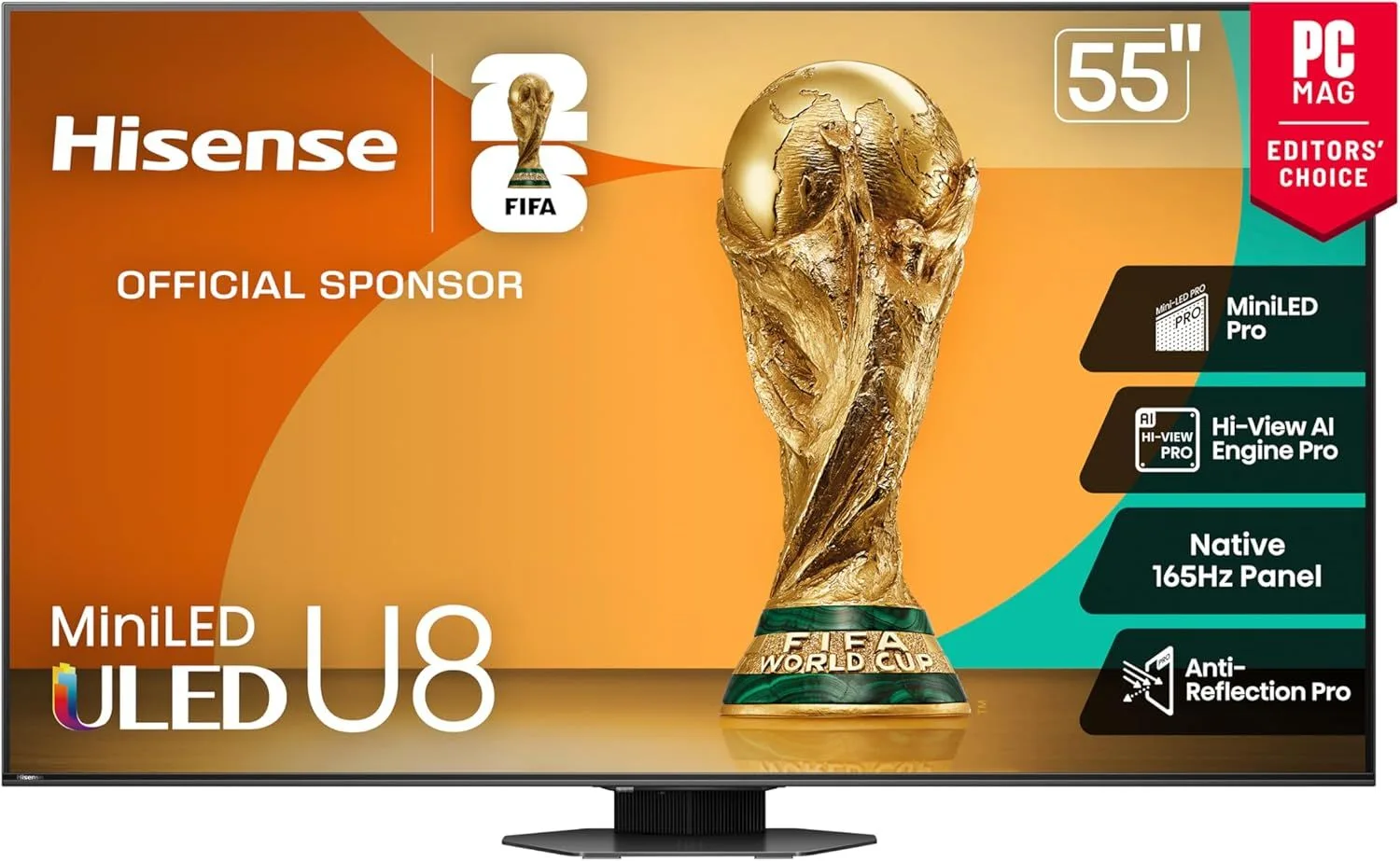
Hisense packs flagship-tier specs into a 55" package: 1000 zones, 2000 nits, 144Hz. The picture quality punches way above its price class. The main compromise is narrow viewing angles.
Flagship Specs, Mid-Range Price
The U8QG's spec sheet reads like a flagship: approximately 1000 dimming zones, roughly 2000 nits of peak brightness, 144Hz with VRR, and dual Dolby Vision plus HDR10+ support. Two years ago, these numbers existed only on TVs costing twice as much. Hisense compressed the technology curve. Fast.
The 2000-nit peak brightness is the headline feature. HDR highlights do not just appear -- they physically pop off the screen. Sunlit landscapes, metallic reflections, fire and explosions in action sequences -- all render with an intensity that entry and mid-range Mini-LEDs cannot approach. In a moderately lit room, the U8QG can out-punch an OLED in brightness-dependent content.
1000 Zones: Near-OLED Contrast
With approximately 1000 zones across a 55-inch panel, each zone is small enough to produce impressive local contrast. Dark scenes in movies have genuine depth. Stars on a night sky are bright points on deep black -- not bright points surrounded by gray haze. The zone density approaches the point where casual viewers cannot distinguish the result from OLED in mixed content.
Demanding test content still reveals the gap. A single white cursor on a fully black screen shows a localized bloom that OLED eliminates entirely. But in real movie content, where frames mix bright and dark elements organically, the U8QG's 1000 zones produce a convincing performance.
Set HDR tone mapping to "Normal" instead of "High" for movies. The U8QG's 2000-nit capability means it can push highlights aggressively, which some filmmakers did not intend. Normal mode respects the content creator's brightness decisions while still delivering punchy highlights.
The Viewing Angle Compromise
VA panels trade wide angles for deep blacks. That's the deal. Sitting 30+ degrees off-center, colors shift and contrast drops noticeably. For a single viewer or a couple watching from the couch center, this is invisible. For a family spread across a wide sectional, the side-seat viewers get a degraded picture.
This is the fundamental trade between VA-panel Mini-LED (deep blacks, narrow angles) and IPS-panel options like LG's QNED82 (wider angles, shallower blacks). Know your seating layout before buying.
Strengths
- ✓~1000 dimming zones for excellent local dimming
- ✓144Hz with VRR for competitive gaming
- ✓Outstanding brightness around 2000 nits
Cons
- ✗Narrow viewing angles from VA panel
- ✗Processing refinement trails Sony
- ✗Sound quality needs a soundbar for the price
OLED Alternative or OLED Rival?
At $500–$800, the U8QG costs less than the LG 55" OLED C5 while delivering higher brightness and competitive contrast. It is not an OLED replacement -- per-pixel dimming and infinite contrast ratio remain OLED-exclusive advantages. But for buyers who want flagship-level HDR performance without OLED pricing, the U8QG closes the gap further than any previous Mini-LED at this tier.
Frequently Asked Questions
Is the Hisense U8QG as good as an OLED?
In a bright room, the U8QG is better than OLED -- 2000 nits crushes the LG C5's 1000 nits in HDR highlights. In a dark room, OLED wins on black levels and viewing angles. The U8QG narrows the gap significantly and costs less than most 55" OLEDs.
Are the viewing angles bad on the U8QG?
The VA panel delivers deep blacks from the center position but washes out noticeably at wide angles. If your setup has viewers at 40+ degrees off-center, the LG QNED82 (IPS panel) handles angles better. For front-facing seating, the VA panel's deeper blacks are an advantage.
Is 2000 nits of peak brightness noticeable?
Very noticeable. HDR highlights -- sunlight through clouds, fire, explosions, metallic reflections -- physically pop on screen. The difference between 800 nits and 2000 nits is not subtle. It is the single biggest visual upgrade the U8QG delivers over mid-range Mini-LEDs.
How does the Hisense U8QG compare to the TCL QM7K?
Both are flagship-tier Mini-LEDs at similar prices. The U8QG has higher peak brightness (~2000 vs ~2000 nits -- comparable). The TCL has better processing refinement and a slightly more polished Google TV implementation. Both are excellent choices. Pick based on price.
Does the U8QG need a soundbar?
At 20W, the built-in speakers are adequate for casual viewing but lack bass and spatial separation. For movie nights, a soundbar with a subwoofer is recommended. The TV's picture quality deserves better audio than 20W speakers can deliver.
Final Verdict
Rating: 4.4/5
Hisense packs flagship-tier specs into a 55" package: 1000 zones, 2000 nits, 144Hz. The picture quality punches way above its price class. The main compromise is narrow viewing angles.
Buy it for flagship Mini-LED brightness and zone count at a fraction of flagship pricing. Skip it if your seating arrangement demands wide viewing angles -- VA panels are not built for that.
Track the Hisense 55" U8QG
We check the price daily and monitor availability. You hear from us when something changes.
Only when something changes. Unsubscribe anytime.